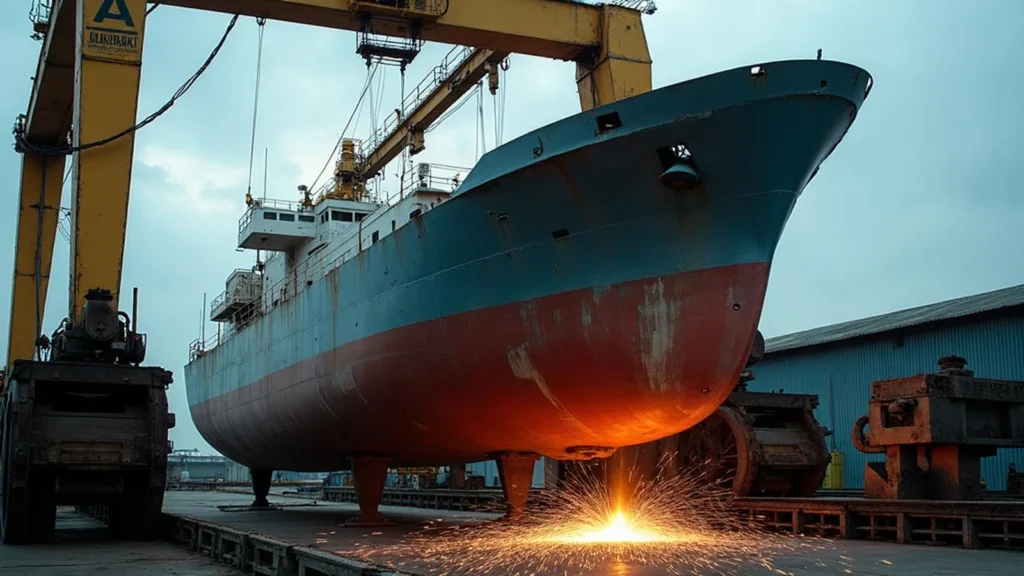
Steel shipbuilding in Indonesia is competitive on fabrication cost and genuinely capable in the major clusters, but quality is a function of the individual yard rather than of the country. The controls that separate a good steel build from a troubled one are welding qualification, dimensional control, material traceability and coating discipline — all verifiable before contract.
Where steel is built
Three clusters dominate. Batam and the Riau Islands hold the largest concentration of private yards, developed around the offshore and marine supply chain, with heavy volume in tugs, barges, crew boats, offshore support vessels and conversions. The Java cluster — Surabaya, Jakarta, Semarang, Lamongan, Cilacap — holds the deepest engineering capability and the largest docks, including PT PAL Indonesia in Surabaya, the country’s largest state-owned shipbuilder. Kalimantan yards specialise in repetitive barge and tug production for bulk logistics. The regional picture is detailed in our shipyard directory.
The build sequence
- Design and approval. Structural drawings approved by the classification society before plate is cut. Building against unapproved drawings is the most expensive gamble available to an owner.
- Material procurement. Plate and sections ordered to the approved grade, arriving with mill certificates checked at delivery, not retrospectively.
- Cutting and forming. Nesting and profile cutting, typically CNC in the larger yards; plate rolling and pressing for curved shell.
- Sub-assembly and block construction. Panels built into blocks, outfitted at ground level with piping, foundations and access, then lifted and joined.
- Erection and hull closure. Blocks joined on the berth; alignment and dimensional control are decisive here.
- Tank and tightness testing. Structural testing before spaces are coated and closed off.
- Surface preparation and coating. Blasting to the specified standard, coating applied within stated environmental limits with recorded film thickness.
- Machinery and outfitting. Main and auxiliary machinery, shafting, systems, accommodation.
- Launch, inclining, sea trial, delivery.
Four capability checks that predict outcome
| Check | What to ask for | What a weak answer looks like |
|---|---|---|
| Welding qualification | Current WPS documents and welder qualification records for the relevant procedures | “Our welders are very experienced” without records |
| Dimensional control | Method for setting out and checking block geometry; calibration records for measuring equipment | Measurement by tape and eye at erection |
| Material traceability | System linking mill certificates to plates as cut and installed | Certificates filed by delivery batch with no link to structure |
| Coating control | Recorded blast standard, dew point, humidity, wet and dry film thickness | Coating applied “when the weather is good” |
Swipe the table sideways for every column
None of these four requires a large yard. Small yards with disciplined procedures outperform larger yards without them, which is why the shortlist described on our newbuild supervision page is built on evidence rather than on reputation.
Dimensional control is the hidden cost driver
Block construction saves time only if blocks meet within tolerance. When they do not, the yard closes the gap with additional weld, inserts and heat — which distorts structure, consumes labour, and produces a hull whose real geometry differs from the drawing. That difference propagates into piping runs, machinery alignment, joinery fit and, eventually, the inclining result. Owners rarely see this happening; they see it in the schedule, three months later, described as “fit-up issues”.
The verification is straightforward: ask how block geometry is set out and checked, and ask to see the check records for a block currently on the ground.
Coating discipline
Coating is where an Indonesian build is most exposed to climate. High humidity and rapid temperature change make dew point control a daily operational discipline, not a specification footnote. Coating applied outside the manufacturer’s stated conditions will fail early no matter how good the product, and the failure appears two or three years later as widespread breakdown in tanks and on the underwater hull — long after the guarantee conversation is over.
The control is recorded conditions: blast standard, surface profile, ambient and steel temperature, relative humidity, dew point, and film thickness readings, all logged per area. A yard that produces those records habitually is a yard whose coatings last.
Owner-supply versus yard-supply
Main engines, generators, navigation packages and specialised deck equipment are frequently owner-supplied on Indonesian builds, because the owner has better access to pricing and support. That is sensible, but it makes the interface the owner’s risk: delivery timing, customs clearance, foundation dimensions and connection specifications all become the owner’s responsibility. Those items belong in the contract as a named schedule with dates, not as a general understanding.
Getting a steel programme right
Specify precisely, tender the same document to every yard, verify the four capability checks before signature, and attend the stages where verification is still possible. That is the whole method. For a capability-led shortlist against your vessel, contact bd@juaraholding.com or +62 811-3941-4563. Contracts are issued by PT Komodo Galangan Nusantara in USD.
Frequently asked questions
What size steel vessels can Indonesian yards build?
Capability ranges from small workboats to large commercial tonnage, but it is unevenly distributed. Batam and the Java clusters hold the largest berths and docks; smaller regional yards are efficient at repetitive hulls within their physical limits. The binding question is always the specific yard, not the country.
How is weld quality verified?
Through approved welding procedure specifications, currently qualified welders, visual inspection, and non-destructive testing — typically radiographic or ultrasonic — sampled according to the class requirements. Verification happens before coating, because coating over unverified weld is effectively irreversible.
What is block construction?
Building the hull as sub-assemblies that are outfitted at ground level and then joined. It is faster and safer than building entirely in situ, but demands dimensional control: blocks that do not meet within tolerance create fit-up problems that consume the time the method saved.