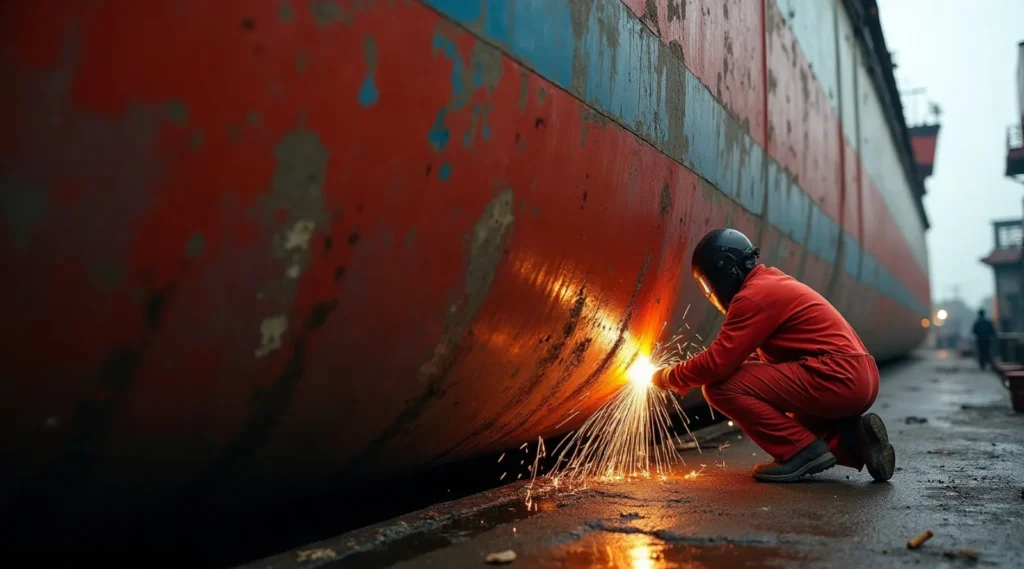
Ship repair in Indonesia is a buyer’s market with a quality spread — the same steel renewal can differ 40% in price and twice that in workmanship between yards. Our desk scopes the job, tenders it to matched yards from the national register, normalises the USD quotes, and supervises execution on the dock floor so the owner pays for work actually done to standard.
Answer first: how ship repair is organised in Indonesia and where owners lose money
Indonesian repair capacity is real and competitively priced, but it is fragmented: hundreds of yards, no national standard of estimating, and wide variance in QA culture. Owners lose money at four predictable points. First, vague scoping — a repair spec without measured quantities invites remeasure inflation. Second, tender mismatch — sending a machinery-heavy scope to a steel-first yard. Third, unsupervised growth work — “found” items priced under time pressure mid-docking. Fourth, acceptance without verification — coatings measured nowhere, welds inspected by the people who made them. Each has a procedural fix, and together they are the desk’s core product.
For works beyond local capacity, class survey and repair scheduling keeps a vessel earning instead of waiting on the hard.
Repair scopes we coordinate nationally
Steel renewal & plate work
Bottom, side-shell and internal steel renewal against thickness-gauging reports; insert plates, frames, brackets and tank-top work. We insist on class-witnessed fit-up and NDT on completion, and on per-kilogram or per-plate rates fixed in the tender — the single biggest lever on final invoice size.
Machinery & engine room
Main engine overhauls, auxiliary engines, pumps, compressors, heat exchangers, and sea-valve overhauls in dock. Where OEM service engineers are needed (common for modern mains), we coordinate their attendance window against the dock schedule so lay days are not burned waiting.
Propeller, shaft, rudder & steering gear
Shaft withdrawal and survey, propeller repair and balancing, stern tube bearings and seals, rudder pintle clearances and steering gear tests. These are survey-linked items: we schedule them so the class surveyor witnesses once, not twice.
Blasting, painting & tank coating
Hull blasting to specified standards, anti-corrosive and antifouling systems, ballast and cargo tank coatings. Coating failures are the most common warranty dispute in Indonesian repair; we lock surface-preparation standard, climate windows, and DFT verification into the contract, with readings taken by someone who answers to the owner.
Electrical & navigation
Switchboard and cabling repair, generator work, and navigation or communication equipment renewal with radio survey coordination where certificates are affected.
Emergency and voyage repairs: coordination protocol
For grounding, contact, machinery failure or class-condition items, the sequence is: stabilise and document (photos, gaugings if safe), notify class and insurers, then place the vessel where scope can actually be executed — which is not always the nearest yard. The desk runs parallel checks: which register yards can take the vessel now, what temporary repairs class will accept for a repositioning voyage, and how the permanent scope should be tendered so an emergency does not become a blank cheque. Afloat repair teams can be mobilised at major anchorages for work not requiring docking.
Repair for foreign-flagged vessels
Foreign-flagged ships repair in Indonesia routinely, Batam being the busiest gateway. The yard’s agent handles the repair-call formalities; your class society attends as normal; parts imported for the repair move under yard customs facilities. The practical differences an owner should plan for are communication cadence and documentation discipline — both solved by having an owner-side representative at the yard who reports in your format, daily.
Independent supervision: why an owner’s eye at the yard changes outcomes
Yard QA answers to the yard. Class attends survey points, not production. The gap between them is where quality drifts and invoices grow. Our supervisors close that gap: they verify quantities before work is invoiced, witness surface prep and DFT readings, hold growth work to pre-agreed rates, and keep a photographic day log the owner sees every evening. On typical dockings the supervision fee is recovered in remeasure discipline alone — before counting the rework it prevents. Supervision can be attached to a repair we tender or engaged standalone at a yard you have already chosen; see selection & vetting for how we shortlist, and the National Yard Register for where.
Scope to price in 48 hours: WhatsApp +62 811-3941-4563 or bd@juaraholding.com. Quotations coordinated in USD.
How a repair engagement runs, start to finish
The sequence we run on every coordinated repair: scope definition against gauging reports and survey status; tender to two or three matched yards from the register; normalised USD comparison with remeasure rules fixed; contract with growth-work rates agreed in advance; supervised execution with daily photographic reporting; and closing verification — quantities measured, coatings DFT-checked, survey items witnessed — before the final invoice is approved. Owners join at whichever step they need: some bring us a scope, some bring us a problem, some bring us an invoice that needs an audit.
Frequently asked questions
Who supervises ship repair quality in Indonesian shipyards?
By default, the yard’s own QA department — which answers to the yard, not to you. Class surveyors attend defined survey points only. Independent owner-side supervision, the service our desk provides, is the only party on the dock floor whose sole job is the owner’s quality and cost position.
How do I get my foreign-flagged vessel repaired in Indonesia?
Select a yard accustomed to foreign tonnage (Batam and major Java yards), let its agent open the repair call with customs and immigration, and have your class society attend as usual. The desk handles yard selection, USD tendering and the paperwork chain as one engagement.
Can Indonesian yards do aluminium hull work?
Yes, a defined subset can — mainly yards serving crew boats and fast workboats, with certified aluminium welders and dedicated tooling. Aluminium scope should never go to a steel-only yard; we shortlist specifically for certified aluminium capability when the hull demands it.
What repair scopes can be done afloat versus in dock?
Afloat: most machinery overhauls, electrical work, pipework, topside steel and superstructure, and diver-assisted inspections. In dock: bottom steel, sea valves, shaft and rudder withdrawal, and full coating systems. We split scopes across afloat and docked phases when it shortens paid dock days.
How is emergency ship repair coordinated across Indonesian ports?
Through parallel placement: the desk checks which register yards can receive the vessel immediately, what temporary repair class will accept for the voyage there, and mobilises afloat teams where docking is not required — while the permanent scope is tendered properly instead of priced under duress.
From the Journal
- Perbaikan Mesin Kapal: Overhaul, Suku Cadang & Standar Pengerjaan di Galangan
- How Long Does Hull Replating Take at an Indonesian Shipyard?
- Antifouling and Hull Coating in Tropical Waters: Intervals That Actually Hold
- Docking Passenger Ferries and Ro-Ro Vessels: What Indonesian Yards Require