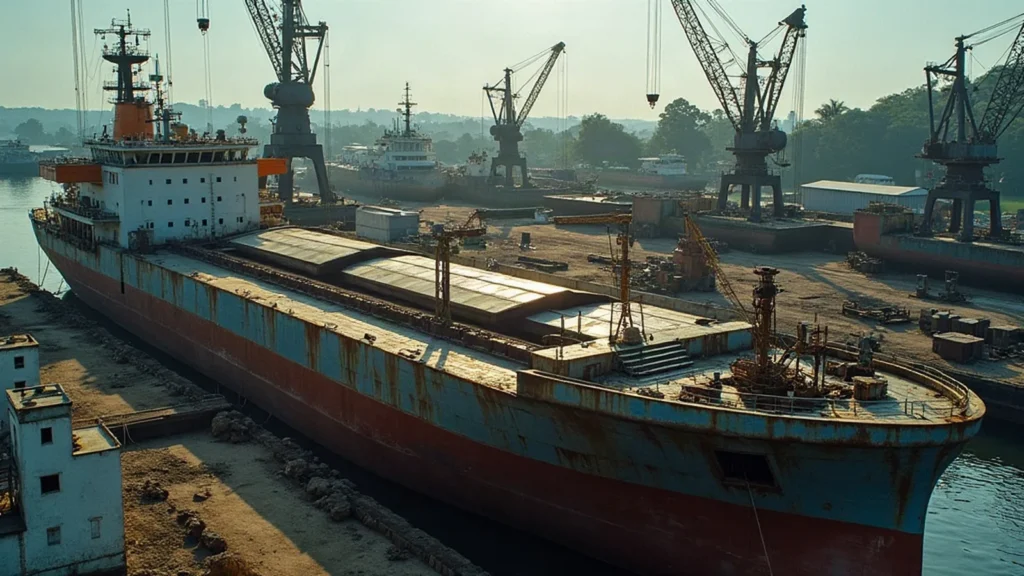
A cargo vessel specification is written backwards from the trade: cargo type, route, ports, and loading method determine the hull, the arrangement and the notation. Indonesian yards build cargo tonnage competently and competitively; the failures that occur are almost always specification failures rather than construction failures.
Start with the trade, not the vessel
Four questions come before any drawing. What cargo, in what form, with what density and handling requirements? Between which ports, with what draught, berth length and shore infrastructure? Under what flag and in what service area — coastal, archipelagic, or international? And with what crewing and operating cost target?
Those answers fix the envelope. A vessel designed for maximum deadweight that cannot enter the intended loading port at a working tide is not efficient; it is unusable. In the Indonesian archipelago, where many ports are shallow, tidal and lightly equipped, port constraints frequently dominate the design more than cargo economics do.
Projects that outgrow a single slipway continue through national newbuild desk for charter tonnage, where contracts, supervision and delivery run under one national desk.
Hull form and dimensions
Length, beam and draught are set by the port envelope and the required deadweight. Beam is often the most valuable dimension in shallow-water trades because it buys deadweight without draught, at some cost in propulsive efficiency. Block coefficient trades capacity against speed and fuel. Where the vessel will regularly take the ground or work alongside unimproved berths, bottom structure and bilge protection need deliberate attention rather than default scantlings.
Cargo arrangement and handling
| Cargo type | Principal specification drivers |
|---|---|
| Dry bulk | Hold shape for discharge, tank top strength, hatch cover type and weathertightness, bilge and ventilation arrangement |
| General cargo | Clear hold dimensions, lashing arrangements, tweendeck options, crane capacity and reach |
| Containers | Cell or lashing arrangement, stack weights, reefer power provision, hatch cover strength |
| Liquid cargo | Tank subdivision, coating or lining, cargo pumping and piping, heating, venting and gas safety, applicable class and statutory regime |
| Vehicles / ro-ro | Ramp geometry and loading, deck heights and strength, ventilation, fire protection |
Swipe the table sideways for every column
Shore infrastructure decides whether the vessel needs its own cargo gear. In many Indonesian regional ports it does, and self-discharging or crane-equipped vessels command their trade precisely because they do not depend on shore equipment. That capability is heavy, high, and affects stability — which is a design conversation, not an afterthought.
Machinery and operating economics
Cargo vessels are judged over decades on fuel and maintenance, not on trial speed. Specification decisions with the longest payback are propeller and hull-form matching at the actual operating speed rather than the maximum, auxiliary sizing that matches real electrical load instead of a generous assumption, an engine and equipment package with genuine service support in the operating region, and access design that lets maintenance be performed without dismantling half the engine room.
That last point is routinely underweighted. An engine room laid out for construction convenience rather than maintenance access costs money every year for the life of the vessel.
Class notation and statutory regime
Cargo, service area and flag together determine the notation and the statutory certificate set. Liquid cargoes, in particular, engage significantly more demanding regimes. These requirements shape structure, systems and equipment, so they must be settled before the specification is issued for tender — the sequencing set out on our class and compliance page.
Yard selection for cargo tonnage
The capability filter is the same as for any steel newbuild — welding qualification, dimensional control, material traceability, coating discipline — with two additions specific to cargo vessels. First, has the yard built this cargo type before? Hatch covers, cargo gear foundations and tank coatings are where inexperience shows. Second, can the yard handle the outfitting content? A general cargo hull is straightforward; a vessel with cargo cranes, hatch covers, reefer provision and complex piping has an outfitting load that some competent hull yards are not equipped for. Regional capability is mapped in our shipyard directory.
Series builds
Where an owner needs several similar vessels, a series build in an Indonesian yard is genuinely economic — the yard amortises setting-out, jigs, procedures and learning across hulls, and the second and third vessels are usually faster and better than the first. The condition is a frozen design. Every change introduced after the first hull erases part of the saving and reintroduces first-of-class risk.
Specification support
This desk writes cargo vessel specifications from the trade backwards, tenders them to capable yards, and supervises construction to delivery. Contracts are issued by PT Komodo Galangan Nusantara in USD. Contact bd@juaraholding.com or +62 811-3941-4563. See also newbuild supervision.
Life-cycle thinking at specification stage
A cargo vessel is a thirty-year asset, and the specification decisions that matter most are the ones whose consequences repeat annually. Coating specification in ballast tanks determines how much steel renewal appears at the second and third renewal surveys. Access design determines how many hours every routine overhaul takes. Equipment brand selection determines whether spares and service are available in the operating region or must be flown in. None of these show up in a first-cost comparison, and all of them show up in the operating account.
Where an owner is choosing between two quotations that differ modestly on price, these are the areas worth interrogating before the decision — because a small first-cost saving purchased with a thinner coating specification is not a saving at all.
Frequently asked questions
What decides the notation for a cargo vessel?
The cargo and the service area. Dry bulk, general cargo, containers, liquid cargo and vehicles carry different structural and systems requirements, and coastal, archipelagic or international service changes subdivision, equipment and certification obligations.
Should hold or tank arrangement follow the cargo or the port?
Both, and in that order of stubbornness. Cargo dictates structural and systems requirements; ports dictate dimensions, draught and handling method. A vessel optimised for cargo that cannot enter its intended ports is a design failure, not a compromise.
Is a series build less expensive than a one-off?
Generally yes, per unit, because the yard amortises setting-out, jigs and learning across hulls. The saving only materialises if the design is frozen before the first hull — changes introduced mid-series remove most of the benefit.