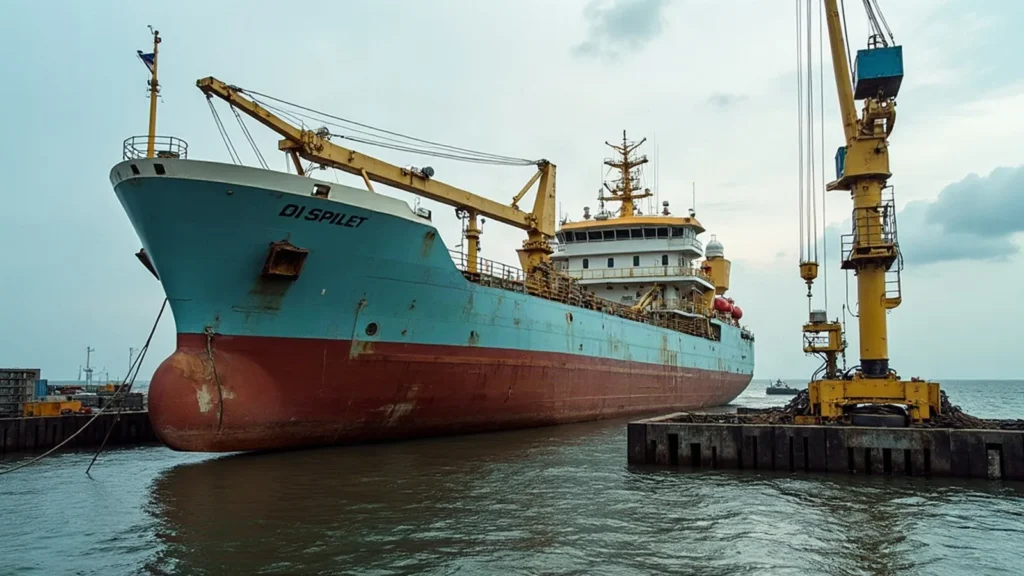
Offshore support vessels are outfitting projects with a hull attached. The steel is the straightforward part; the risk sits in station-keeping, deck machinery, tank and cargo systems, and the electrical integration that ties them together. Indonesian yards — particularly in the Batam and Riau cluster — have real OSV experience, but the capability question is sharper here than for simple cargo tonnage.
Fix the mission first
“OSV” covers vessels that share very little. A platform supply vessel is defined by deck area and tank capacity. An anchor handling vessel is defined by bollard pull, winch capacity and stern roller arrangement. A crew transfer vessel is defined by seakeeping, transfer arrangement and passenger certification. An accommodation or construction support vessel is defined by berths, station-keeping and crane capability.
Each implies a different hull, a different machinery arrangement and a different class notation set. Attempting to keep the mission open “for flexibility” produces a vessel that performs every role adequately and none competitively — and the market prices that accordingly.
Deck and tank arrangement
For supply-type vessels the two governing numbers are clear deck area with its permissible loading, and the tank set. Tanks are not generic capacity: fuel, fresh water, drill water, brine, mud, cement and dry bulk each carry their own structural, coating, piping and pumping requirements, and a tank arrangement designed for one client’s cargo mix can be poorly matched to the next charter. Where the vessel is being built speculatively rather than against a contract, tank flexibility is worth real money.
Station-keeping
| Capability | Implication |
|---|---|
| Manual / basic thrusters | Lowest cost; limits the work the vessel can accept |
| Dynamic positioning, single system | Redundancy limited; acceptable for many support roles |
| Dynamic positioning with redundancy | Significant power, switchboard, thruster and control implications; substantial cost and integration risk |
Swipe the table sideways for every column
Station-keeping is the single largest driver of electrical complexity on an OSV. Power generation and distribution, thruster selection, control systems, sensors and their redundancy all follow from it, and the commissioning and trials programme grows accordingly. Owners specifying a redundant capability should understand that they are buying a systems integration project, and should confirm the yard has completed one before.
Class notation and statutory regime
Notations for offshore support work — covering station-keeping capability, firefighting, oil recovery, dangerous goods carriage, and accommodation of industrial personnel where applicable — each bring equipment and survey obligations. The regime is settled before design, since it drives structure, systems and equipment. The sequence is on our class and compliance page.
Yard capability checks specific to OSV work
- Prior delivery of a comparable mission package — not simply a hull of similar size.
- In-house or reliably subcontracted electrical integration capability, with evidence of commissioning documentation from a previous project.
- Deck machinery experience — winch foundations, stern rollers, cranes and their structural interfaces are unforgiving of approximation.
- Commissioning and trials discipline — a documented systems commissioning programme, not an ad hoc handover.
- Vendor coordination — the ability to manage multiple equipment suppliers, their engineers and their schedules.
These sit on top of the four universal steel-build checks described in our article on steel ship construction in Indonesia.
Owner-supplied equipment
Main machinery, thrusters, dynamic positioning systems, winches and cranes are often owner-supplied, and on an OSV that decision carries more weight than usual. Interfaces multiply: foundation dimensions, power requirements, control signals, spares, and vendor commissioning attendance. Every one of those becomes an owner risk unless the contract states delivery dates, technical interface responsibility and who pays when a vendor engineer arrives late. That schedule belongs in the contract as an annex, as described in our article on shipbuilding contracts.
Trials and acceptance
OSV acceptance is a multi-part exercise: conventional speed and manoeuvring trials, bollard pull where applicable, deck machinery load testing, station-keeping capability trials against the notation requirements, and systems commissioning records. Every one of these should have numerical acceptance criteria in the contract. Bollard pull in particular must specify the test conditions, because the figure is meaningless without them.
Market reality
Offshore support tonnage is a cyclical asset class, and a vessel built without a charter behind it is a bet on the cycle. That is the owner’s commercial judgement, but it should influence specification: broader mission capability and tank flexibility cost more to build and are worth more in a soft market, while a narrowly optimised vessel is worth most when it exactly matches an available contract.
Support available
This desk specifies OSV newbuilds from the mission backwards, filters yards on the checks above, and supervises the outfitting and commissioning phases where the risk actually is. Contracts are issued by PT Komodo Galangan Nusantara in USD. Contact bd@juaraholding.com or +62 811-3941-4563.
Frequently asked questions
Do Indonesian yards build OSVs?
Yes — the Batam and Riau cluster in particular grew around the offshore and marine supply chain and has substantial experience with support vessels, crew boats, utility vessels and conversions. Capability still varies by yard and by the complexity of the mission package.
What is the hardest part of an OSV build?
Outfitting, not the hull. Station-keeping systems, deck machinery, cargo and tank systems, firefighting where fitted, and the electrical integration behind them carry far more risk than the steelwork.
How much does the mission profile change the design?
Fundamentally. Platform supply, anchor handling, crew transfer, accommodation and construction support are different vessels with different deck areas, tank sets, machinery and station-keeping requirements. The mission must be fixed before design begins.