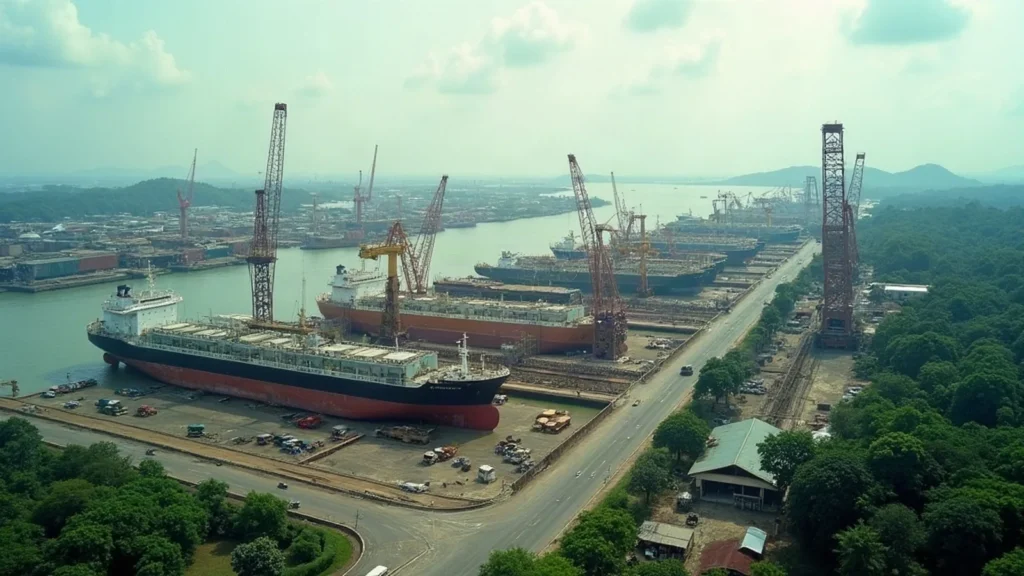
Indonesian shipbuilding is best understood as five regional industries that happen to share a country, not as a single national sector. Materials, customers, vessel types and physical capacity differ sharply between them. Any assessment that treats “Indonesian yards” as one category will be wrong about at least four of the five.
The structural picture
The industry divides along two axes. The first is ownership: a small number of large state-linked yards with heavy engineering and naval capability, and a very large number of private yards ranging from substantial commercial operations to single-slipway facilities serving a local fleet. The second is material: steel and aluminium fabrication on one side, and a living wooden shipbuilding tradition on the other, with almost no overlap in workforce, method or geography.
An archipelago of this size generates constant demand for tonnage — inter-island cargo, ferries, fishing vessels, workboats for resource industries, tourism and liveaboard vessels, and government craft. That demand is dispersed, which is why yard capacity is dispersed too.
The five clusters
| Cluster | Core capability | Typical output |
|---|---|---|
| Batam & Riau Islands | Steel fabrication, repair, conversion; largest private concentration | Tugs, barges, crew boats, offshore support vessels |
| Java — Surabaya, Jakarta, Semarang, Lamongan, Cilacap | Heaviest engineering depth and dock capacity; PT PAL Indonesia in Surabaya | Large commercial and government vessels, complex conversions |
| South Sulawesi — Bulukumba, Tana Beru, Bira, Ara, Makassar | Traditional wooden shipbuilding; steel repair at Makassar | Large wooden sailing hulls, working and tourism craft |
| Kalimantan — Banjarmasin, Samarinda, Pontianak, Balikpapan | Series production for river and bulk logistics | Barges, tugs, river craft |
| Eastern Indonesia — Bali, Lombok, Labuan Bajo, Sorong, Bitung | Haul-out, seasonal refit, systems and interior trades | Service rather than construction |
Swipe the table sideways for every column
What Indonesia builds well
Four segments stand out. Workboats and support vessels: tugs, barges, crew boats and utility craft, where steel fabrication cost and regional demand align. Repair and conversion: substantial dock capacity in Batam and Java serving regional traffic, with competitive labour rates for steel renewal. Series production: repetitive hulls for bulk logistics, where Kalimantan yards are efficient. Traditional wooden vessels: a genuinely distinctive capability, since few places still build large wooden sailing hulls commercially.
Where the constraints are
Three limits shape what is realistic. First, imported equipment content: main machinery, propulsion, navigation and specialised systems are largely imported, so lead time and customs clearance are schedule items in their own right and a share of the cost is not local. Second, supply-chain depth: outside Batam and Java, the subcontractor and vendor ecosystem thins quickly, which affects complex outfitting more than hull work. Third, quality dispersion: the gap between the best and worst yard within a single bay can exceed the gap between countries, which is why yard-level verification matters more here than national generalisation.
How buyers should read the industry
- Do not shop by country. Shortlist by cluster, then by yard, then verify capability with documents.
- Match complexity to cluster. High outfitting content belongs where the vendor ecosystem is; simple repetitive hulls do not need to be.
- Treat imported equipment as its own project. Order early, clear customs early, and put the schedule in the contract.
- Verify rather than infer. Welding qualification records, dimensional control method, material traceability and coating logs are all checkable before signature — see our article on steel ship construction.
The regulatory frame
Technical oversight runs through classification — principally Biro Klasifikasi Indonesia — with statutory certification under the Ministry of Transportation through the Directorate General of Sea Transportation. Domestic sea transport operates under a cabotage regime reserving carriage between Indonesian ports for Indonesian-flagged vessels operated by Indonesian legal entities, which underpins much of the domestic newbuild demand. The practical consequences for owners are set out on our class and compliance page.
Reading capacity claims critically
Published yard counts and capacity figures for Indonesia vary widely because definitions vary: some counts include every registered facility with a slipway, others only yards with dock capacity above a threshold. Treat any single headline number as a definition rather than a measurement, and work instead from the physical question that matters — can this specific yard take this specific vessel, and has it done so before?
Where to go next
The region-by-region capability map is in our shipyard directory, and the Indonesian-language treatment is on galangan kapal Indonesia. For a capability-led shortlist against a specific vessel, contact bd@juaraholding.com or +62 811-3941-4563. Scopes and contracts are issued in USD by PT Komodo Galangan Nusantara.
Direction of travel
Two forces are reshaping the sector. Domestic demand remains structurally supported by an archipelagic economy and by the cabotage regime that reserves inter-island carriage for Indonesian-flagged tonnage. At the same time, regulatory expectations on emissions, safety and documentation continue to rise internationally, and yards that build documentation discipline into their process are better placed than those that treat it as paperwork bolted on at the end. For an owner, that is a selection criterion available today: ask to see the records, not the brochure.
Frequently asked questions
How many shipyards does Indonesia have?
Published counts vary widely depending on whether small slipways and repair-only facilities are included, so any single number is a definition rather than a fact. What is stable is the distribution: a small number of large yards with dock capacity, and a very large number of small facilities serving local fleets.
Which yard is the largest?
PT PAL Indonesia in Surabaya is the largest state-owned shipbuilder and carries the heaviest construction capability. Measured by combined private dock capacity and yard count, the Batam and Riau Islands cluster is the largest concentration.
Is Indonesian shipbuilding competitive internationally?
It is competitive in specific segments — workboats, barges, tugs, support vessels, repair and conversion, and traditionally built wooden hulls — rather than across the board. Competitiveness comes from labour cost and location, and is limited by imported equipment content and supply-chain depth.