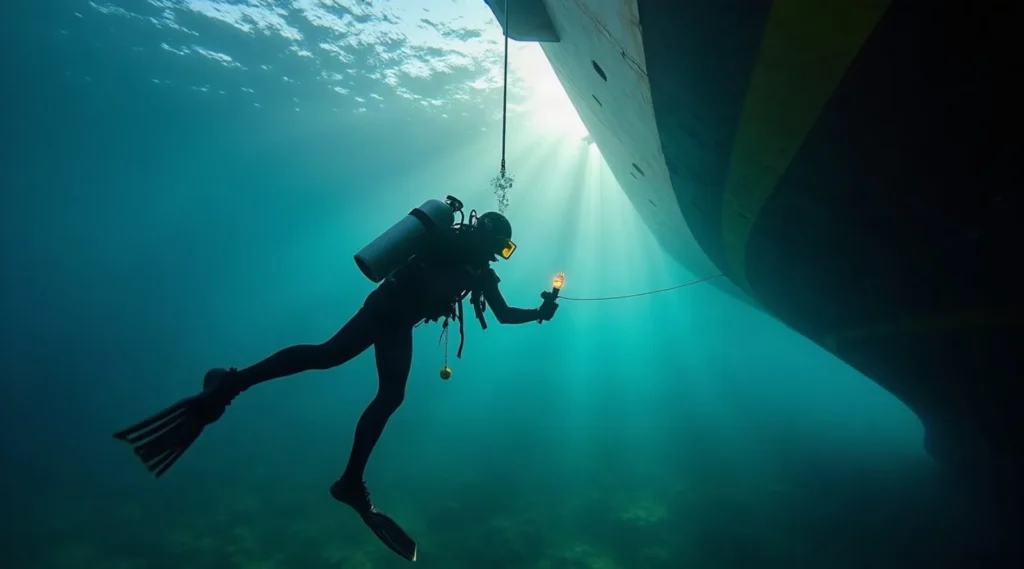
Extended Dry Docking (EDD) is a class-approved programme that stretches the interval between dry dockings from the standard maximum of 36 months to as much as 7.5 years, replacing intermediate dockings with in-water surveys. It is available only to a narrow band of ships — typically younger, well-coated cargo tonnage with the right notations — and it trades dock time for a stricter continuous inspection regime. Here is who qualifies, what changes operationally, and how to think about it for vessels trading in Indonesian waters.
The baseline rule EDD modifies
Under normal classification rules, every ship’s underwater hull must be examined in dry dock twice in each five-year class period, with no more than 36 months between examinations. EDD programmes, offered by major classification societies under their own scheme names, permit enrolled ships to substitute approved in-water surveys (IWS) for intermediate dockings, so the hull may stay wet for up to 7.5 years between actual dockings. The special survey and its docking still anchor the cycle — EDD does not remove dockings forever; it thins them out. Enrolment is a formal act: the society reviews the ship, imposes conditions, and the flag administration must accept the arrangement.
Who qualifies — and who does not
| Factor | Typical EDD requirement |
|---|---|
| Ship age | Young tonnage; commonly enrolment before 10–15 years of age |
| Ship type | Mostly dry cargo/container/general cargo; tankers, passenger ships and high-risk types generally excluded |
| Coating condition | Underwater coating in good, documented condition; high-performance systems favoured |
| Notations & equipment | In-water survey notation; markings on hull for diver orientation; cathodic protection in order |
| Operational profile | Trading pattern allowing clear-water IWS with acceptable visibility |
Swipe the table sideways for every column
The excluded categories matter as much as the included ones: if your fleet is tugs, ferries, landing craft or tourism vessels — the bulk of Indonesian coastal tonnage — EDD is generally not on the table, and the classic docking rhythm described in our dry dock guide continues to govern.
What EDD changes in practice
Three things. First, survey style: intermediate bottom examinations happen in the water, by approved diving contractors with surveyor oversight, often with hull cleaning beforehand so cameras can see steel and coating. Second, maintenance discipline: the programme survives only as long as the coating and cathodic protection do — owners effectively commit to premium antifouling systems, careful anode management and prompt touch-ups at every opportunity. Third, documentation: every IWS report, cleaning record and coating assessment becomes part of the class file; a gap in the paper trail can end the enrolment. The economics are straightforward: fewer dockings mean fewer off-hire periods and dock fees, offset by IWS costs, higher coating investment and the risk that a failed IWS forces an unplanned docking anyway.
EDD and Indonesian operations: the practical view
For owners running qualifying tonnage through Indonesian waters, two local realities shape the decision. Tropical fouling pressure is high — warm water accelerates growth, which stresses coatings and makes clean IWS conditions harder to maintain; the interval assumptions behind EDD were not written for the tropics, so coating specification and cleaning cadence must be planned conservatively — our note on antifouling in tropical waters covers the interval mathematics. Second, when the eventual docking does come due, it is bigger: seven-plus years of deferred bottom work concentrates into one long stay, so yard selection and slot booking matter more, not less. The national options by dock type and capacity are mapped in the National Yard Register, and the survey mechanics on the class side are covered in our BKI class & compliance guide.
Dry berth: the term EDD searches often confuse
A dry berth is not a survey programme — it is long-term storage of a vessel ashore, on blocks or cradles, common for yachts and laid-up craft. A vessel on a dry berth is out of the water and out of service; a vessel on EDD is in the water and in service with special survey arrangements. If your goal is preserving an idle vessel rather than stretching survey intervals on a trading one, the questions to ask a yard are about cradle design, shade, ventilation and periodic system runs — a different conversation entirely, and one our desk also arranges at Indonesian yards.
Should you pursue EDD? A short decision frame
Ask four questions. Is the ship young, well-coated and of an eligible type? Does the trading pattern give reliable access to clear-water IWS locations? Will the fleet organisation sustain premium coating and documentation discipline for years? And do the avoided off-hire days genuinely outweigh IWS and coating costs in your operating model? Four yeses make EDD worth a formal conversation with your class society. Any no — and for most Indonesian coastal operators the type test alone answers it — means the better investment is running the standard cycle well: disciplined slots, tight specifications and owner-side supervision at the dock.
Working through docking strategy for your fleet? The desk advises on survey scheduling, yard selection and supervision across Indonesia — whether standard cycle or extended programme. WhatsApp +62 811-3941-4563 · bd@juaraholding.com. Estimates in USD.
Frequently asked questions
What is extended dry docking?
A class-approved programme allowing eligible ships to stretch the interval between dry dockings to as much as 7.5 years, substituting approved in-water surveys for intermediate dockings, under strict conditions on age, type, coating and documentation.
Which ships qualify for EDD?
Typically younger dry cargo and container tonnage with good underwater coatings, in-water survey notations and clean class records. Tankers, passenger vessels and most small coastal types are generally excluded.
Does EDD remove the special survey docking?
No. The special survey cycle remains the anchor; EDD thins out the dockings between renewals but the ship must still dock for class renewal requirements, and a failed in-water survey can trigger a docking at any time.
Is EDD practical in tropical waters like Indonesia?
It can be, but tropical fouling pressure demands conservative coating specifications and disciplined cleaning; the enrolment assumptions must be maintained continuously or the programme lapses back to standard intervals.