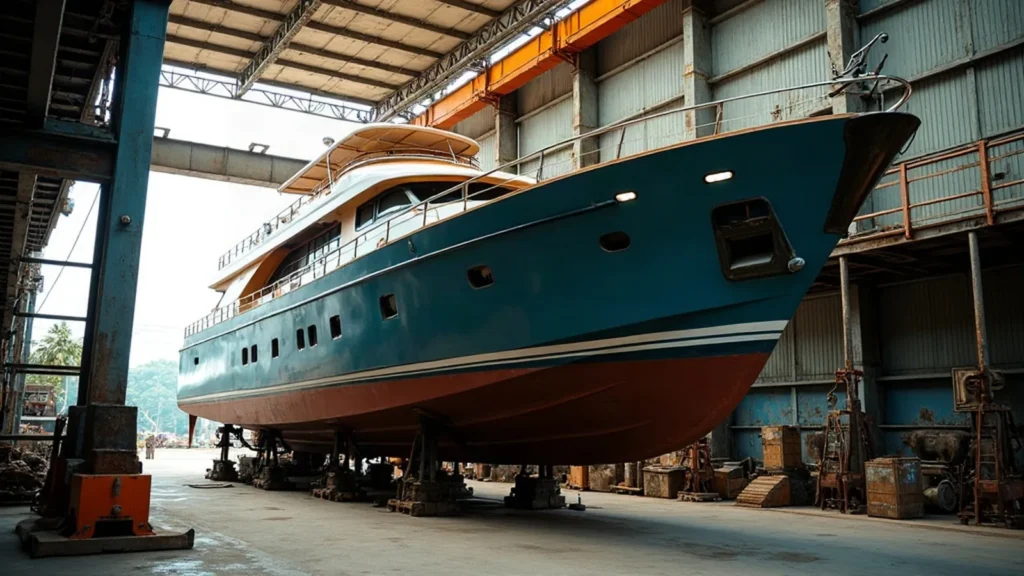
A yacht or liveaboard refit in Indonesia is three projects running in one hull: structural work, systems work and interior work. They have different trades, different suppliers, different risk profiles and different natural locations. Managing them as one undifferentiated total is the reliable way to overrun.
Separate the three packages
Structural. Steel or timber renewal, tank work, deck and superstructure modification, anything affecting the vessel’s approved arrangement. Scoped from evidence — gauging, survey findings, shipwright inspection — and carrying class consequences where the arrangement changes.
Systems. Propulsion, generators, electrical distribution, HVAC and refrigeration, watermakers, navigation and communications, safety equipment. Dominated by equipment lead time and vendor commissioning rather than by labour.
Interior. Joinery, soft furnishing, finishes, galley and guest-area work. Labour-intensive, highly visible to the end client, and the package most vulnerable to scope creep because changes look small and are not.
Fixing each package against its own written scope, with its own variation control, is what makes a refit budget hold. It also allows one package to be cut without renegotiating the others when the structural work grows — which it usually does.
Choosing where to do it
| Work type | Natural location | Why |
|---|---|---|
| Heavy steel renewal | Batam, Java, Makassar | Dock capacity, plate handling, welding capability |
| Timber hull work | South Sulawesi; some eastern facilities | Shipwright skill and timber supply |
| Systems and commissioning | Bali and other service hubs | Equipment logistics, vendor access, technician availability |
| Interior and finish | Near the operating market | Trade availability and owner supervision |
Swipe the table sideways for every column
Splitting a scope across two locations is normal and frequently faster than forcing everything into one facility. The condition is that the transit leg is planned as part of the project — including the vessel’s certificate status and insurance cover during that passage. Regional capability is mapped in our shipyard directory.
Sequencing around a season
Charter and liveaboard vessels refit against a season, not against a survey cycle alone, which compresses everything into the same months and makes slots scarce. The working order is: fix the class survey dates first, because they are immovable; fix the season’s first commercial commitment second; then find a yard window that fits between them, with contingency. Booking a slot first and fitting the survey around it is how vessels end up sailing with open conditions of class.
Equipment lead time is the schedule
On systems-heavy refits the critical path is almost never labour. It is ordering, shipping and clearing imported equipment, then getting vendor engineers on site to commission it. Practical controls: order long-lead items before the vessel arrives; confirm customs documentation requirements early; specify who is responsible for clearance and who pays for delay; and schedule vendor attendance with a named date in the contract rather than “on completion of installation”.
Class consequences of a refit
Anything that changes weight, arrangement, capacity or machinery can reach back into the approval chain — re-inclining, revised stability approval, tonnage re-measurement where enclosed volume changes, or class re-approval of the modified arrangement. Identifying those consequences during scoping is inexpensive; discovering them at survey after the work is complete is not. The triggers are listed on our class and compliance page, and tonnage implications in our article on gross tonnage.
Controlling the interior package
Interior work overruns because changes are easy to request and hard to price mid-flight. Two controls work. First, freeze the interior specification — materials, finishes, layout — before work starts, and treat changes as formal variations with cost and schedule impact stated. Second, sequence interior work last in each compartment, after systems in that space are installed and tested. Fitting joinery before the systems behind it are commissioned guarantees that the joinery comes out again.
What good looks like at handover
A completed refit should deliver more than a clean vessel: updated as-built documentation for anything modified, commissioning records for every system installed, certificates reissued where class or statutory status changed, warranty documentation for installed equipment, and a closed punch list — or an open one with named dates. Ongoing technical and commercial management of the vessel afterwards is a separate contract, issued by PT Komodo Vessel Management.
Scoping a refit
Send the class status, any gauging or survey reports, the equipment list and the season deadline to bd@juaraholding.com or +62 811-3941-4563. Refit contracts are issued by PT Komodo Galangan Nusantara in USD, with the three packages scoped separately. See also ship repair and refit.
A realistic contingency
Every refit of a vessel with service history discovers something. Opening a deck reveals corrosion under a fitting; removing joinery reveals wiring that was never as-built; lifting a sole board reveals a tank top in worse condition than the gauging sampled. A refit plan with no contingency is not an optimistic plan — it is an incomplete one. Carrying a contingency, agreed with the owner and held separately from the scope, keeps discoveries from becoming disputes.
Frequently asked questions
Where are yacht refits done in Indonesia?
Structural and steel work near the larger docks; systems and interior work in the eastern service locations — Bali, Lombok, Labuan Bajo — where trades and logistics are matched to yacht work. Splitting the scope between locations is normal and often faster.
How is a refit budget controlled?
By separating structural, systems and interior packages, fixing each against a written scope, and requiring signed variations for anything outside it. Refits overrun when the three packages are managed as one moving total.
When should a refit be scheduled?
Around the operating season and the class calendar, not around yard availability alone. The sequence that works is: fix the survey dates, fix the season, then find a slot that fits both — rather than taking the first available slot and hoping.