Answer first
Answer first: what dry docking options exist in Indonesia and how are slots booked?
Every docking starts with three data sets: vessel geometry, the survey clock, and the work scope. Those three decide which of the four dock types can physically and commercially take the job.
Every docking starts with three data sets: vessel geometry (LOA, beam, loaded draft, displacement), the survey clock (when class requires the ship out of water), and the work scope. Those three decide which of the four dock types can physically and commercially take the job. Booking is direct with each yard — there is no national booking system — which is why owners without local presence lose weeks emailing yards one by one. The desk compresses that: one enquiry, parallel slot checks across the register, comparable USD quotations back on one sheet.
Two timing realities shape everything. First, docking demand peaks ahead of monsoon-season trading and at fiscal-year fleet cycles, so the best docks sell out earliest exactly when you want them. Second, a docking booked without survey alignment is a docking you may have to repeat — the lowest-cost slot is worthless if your surveyor cannot attend or your certificates lapse mid-refit.
Dock types
Dock types available nationally
Graving docks
Concrete basins with caisson gates, concentrated at state-owned yards in Surabaya and Jakarta and at Batam's large private facilities. Choose graving for heavy steel renewal, shaft and rudder withdrawal, and long-stay refits where crane access over the full hull matters. Constraints are entrance breadth and sill depth; dues are the highest of the four types.
Floating docks
Submersible pontoons rated by lifting capacity in tonnes. The workhorse of Indonesian commercial docking: faster cycles, competitive pricing, wide availability from Batam to Banjarmasin. The binding limit is displacement, not length — a light 90 m vessel may fit where a dense 70 m tanker cannot. Verify the dock's current certified lift, not its build rating.
Slipways
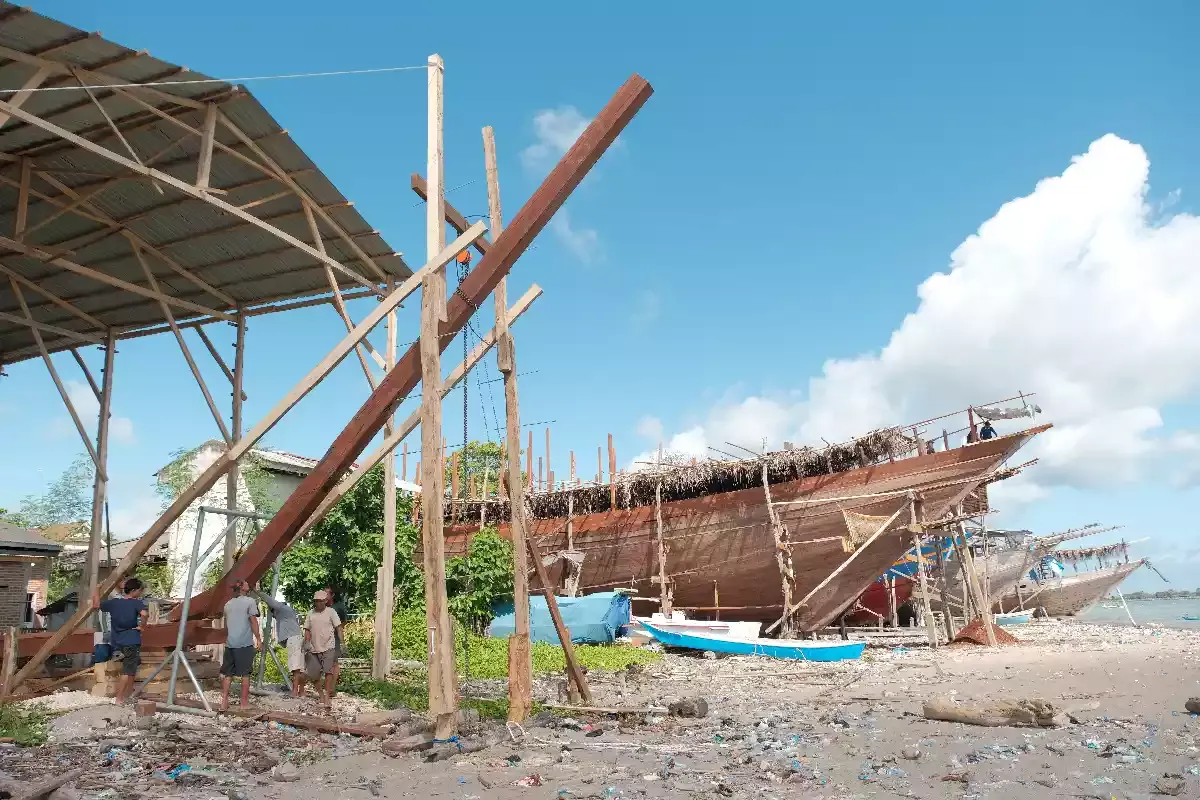
Rail-and-cradle systems hauling vessels bow- or stern-first up an incline. Ideal for tugs, LCTs, ferries and fishing vessels up to roughly 2,000–2,500 GT. Cradle condition and winch capacity are the safety-critical items; ask for the last load test date before you commit.
Airbag haul-out for smaller tonnage
Rubber-airbag beaching has spread fast for barges, tugs and charter vessels, especially in Kalimantan and the East. It is the lowest-cost route out of the water, and perfectly sound when block plans and bag pressures are engineered properly — and hull-damage risk when they are not. This is the dock type where independent supervision changes outcomes most.
Screening logic
Matching dock to vessel: LOA, beam, draft, GT
Screening logic our desk applies before any quotation request:
| Vessel profile | First-choice dock | Watch item |
|---|---|---|
| Tug / workboat to 500 GT | Slipway or airbag | Cradle/bag block plan, keel line support |
| LCT / small cargo 500–2,500 GT | Slipway or floating dock | Winch load test; dock lift certificate |
| Cargo / tanker 2,500–20,000 DWT | Floating dock | Certified lift vs displacement; keel block layout |
| Bulker / large tanker 20,000–80,000 DWT | Graving or large floating (Batam, Surabaya) | Entrance breadth, sill depth vs draft |
| Ferry / ro-ro | Graving or floating with shore ramps | Side-shell access for ramp and door work |
| Liveaboard / charter vessel to 55 m | Slipway or airbag (East, Sulawesi) | Timber or composite hull support spacing |
Swipe the table sideways for every column
A 60 m landing craft, to take the classic case, is almost always better served on a well-run slipway than in a graving dock it would rattle around in — the dues difference funds the entire coating scope.
Booking windows and survey alignment with BKI cycles
Classed vessels must be drydocked twice in each five-year special survey period, with an interval that class rules cap (BKI practice follows the international 36-month maximum between bottom inspections; extended schemes exist for eligible vessels). The efficient pattern is to lock the dock slot to the survey due window, then build the commercial scope around it. Practical lead times we see: 6–10 weeks for mid-tier floating docks and slipways, 8–16 weeks for flagship graving docks, longer before peak season. Emergency dockings can be placed faster through yards with standby capacity — at a price premium that supervision usually claws back in scope discipline.
Our booking desk: slot search, quotation, supervision add-on
Send vessel particulars, class status and target window; the desk returns live slot options from the National Yard Register, normalised USD quotations, and a recommendation with reasons. Add docking supervision and our people stand at the dock during hauling, blocking, survey and undocking — the points where money and risk actually move.
WhatsApp the desk: +62 811-3941-4563 · bd@juaraholding.com. Quotations are coordinated in USD; government fees may be quoted in IDR.
Questions
Frequently asked questions
How often must a BKI-classed ship dry dock in Indonesia?
What is the difference between a graving dock and a slipway haul-out?
How far in advance should a dry dock slot be booked in Indonesia?
Can foreign-flagged vessels dry dock at Indonesian shipyards?
Which dock type suits a 60 m landing craft?
Explore the Register
Send vessel particulars, class status and target window
The desk returns live slot options from the National Yard Register, normalised USD quotations, and a recommendation with reasons. Supervision can be added to the same booking.
Quotations in USD · government and port fees may be quoted in IDR