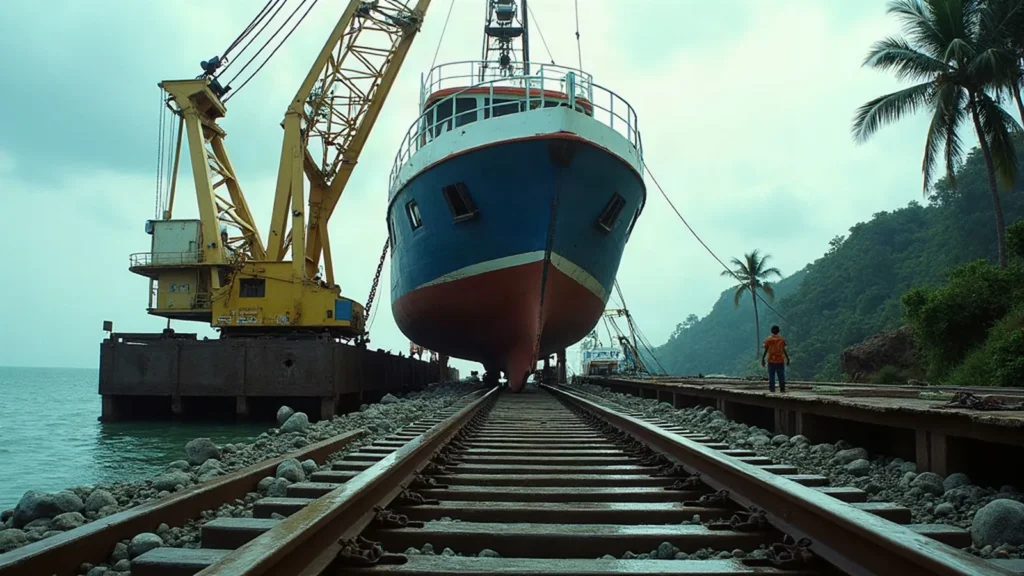
A haul-out in Indonesia is a scheduling problem wrapped around a survey window. The technical work is routine; what determines cost is whether the facility fits the vessel, whether the slot holds, and whether the sequence on the hard is disciplined. Get those three right and the rest is labour.
The five numbers that pick the facility
- Length overall against cradle or dock length, including any overhang the facility will not accept.
- Beam against dock width or travel-lift sling spacing.
- Draught against depth over the sill or over the cradle at the working tide.
- Displacement against rated lift or dock capacity, calculated with the fuel, water and stores actually on board — this is where lift overloads happen.
- Hull form against block and cradle geometry: deep keels, bulbous bows, propeller pods, stabiliser fins and transducers all constrain where load can safely be taken.
These five decide the shortlist before price is discussed, as set out on our dry dock and haul-out page.
Facility types available in Indonesia
| Type | Where | Practical note |
|---|---|---|
| Graving and floating docks | Batam, Surabaya, Jakarta, Semarang, Makassar | Largest capacity; committed schedules |
| Marine railway slipways | Widely distributed | Workhorse for fishing and workboats; cradle geometry matters |
| Travel lifts and hardstands | Bali, Lombok and other yacht-service locations | Convenient for yachts within the rated capacity |
| Air-bag haul | Traditional yards, South Sulawesi and elsewhere | Effective for wooden hulls; requires suitable beach and tide |
Swipe the table sideways for every column
The docking plan
A docking plan shows where the hull can bear load — keel blocks, bilge blocks and side supports positioned clear of transducers, sea chests, stabiliser fins and thin structure. Without it, blocks are placed by eye. Damage from a badly blocked hull is expensive, sometimes structural, and entirely avoidable. If the vessel does not have a docking plan, producing one is a small piece of work that should happen before the first haul-out, not after the first incident.
Sequence on the hard
Haul and block. High-pressure fresh-water wash while growth is still soft. Inspect and photograph before any preparation — this is the only moment the real condition is visible and recordable. Gauge the hull if thickness measurement is due. Open sea valves, strip anodes. Complete steel, shaft and rudder work. Prepare surfaces to the specified standard. Coat within the stated environmental limits, recording film thickness. Renew anodes. Reinstate gear. Undock.
Two rules save more than any negotiation: photograph before preparation, and never coat before rectification in that area is signed off. Recoating over new work is pure loss.
Seasonal and regional reality
Monsoon and swell windows govern transit legs, and humidity governs coating quality. Coating applied outside the manufacturer’s dew-point and humidity limits will fail early regardless of product cost — and in a tropical climate those limits are a daily operational constraint, not a footnote. Facilities in the eastern charter regions are busiest immediately before and after the main cruising season, which is exactly when every operator wants the same slot.
Cost structure and exclusions
Haul-out quotations separate into lift or dock charges (usually entry plus daily lay rate), services, hull treatment, and the repair scope itself. The services line is where quotations diverge: staging, power, water, waste disposal, cleaning, gas-freeing and tank access are frequently excluded from headline numbers and charged as extras. Ask for services itemised, and treat a quotation that does not itemise them as incomplete rather than low-cost.
Making the survey window pay
The reason the vessel is out of the water is usually a survey requirement, so the survey items should be scheduled first and the cosmetic work fitted around them. That means confirming surveyor attendance before fixing the slot, having the thickness measurement contractor booked, and having the class status and outstanding conditions in hand — the two documents that drive every repair scope, as described on our repair and refit page and in our article on docking intervals and survey cycles.
Planning support
Send the docking plan, particulars and survey status to bd@juaraholding.com or +62 811-3941-4563, and the facility shortlist follows from the five numbers. Scopes are issued in USD with services itemised; contracts are issued by PT Komodo Galangan Nusantara.
What to have ready before the vessel arrives
- Docking plan and general arrangement, sent to the facility in advance so blocks are laid before arrival rather than improvised on the day.
- Class status and outstanding conditions, so mandatory work is identified before discretionary work is scheduled.
- Gauging booked where thickness measurement is due, with the contractor’s attendance confirmed against the docking date.
- Coating specification agreed, including surface preparation standard, product system, film thickness and environmental limits for application.
- Written scope with itemised services, so the extras conversation happens before the vessel is immobile.
Arriving with these five documents converts a haul-out from an open-ended exercise into a defined package. Arriving without them means the scope is written while the vessel is already on the hard and paying a daily lay rate, which is the worst possible negotiating position.
Frequently asked questions
How early should a haul-out be booked?
Weeks to months depending on facility size, region and season. Availability is the binding constraint far more often than price, and a missed slot generally costs more than the haul-out itself.
What is the most common avoidable cost?
Discovering additional work after the coating has been applied. Wash, inspect and photograph before any preparation begins, and do not start coating until steel, shaft and rudder work in that area is complete and signed off.
Can a vessel be surveyed in the water instead?
In-water survey is permitted in defined circumstances depending on vessel type, age and class arrangement, and requires an approved diving contractor and appropriate hull condition. It is an option to check with class, not an assumption to build a plan on.