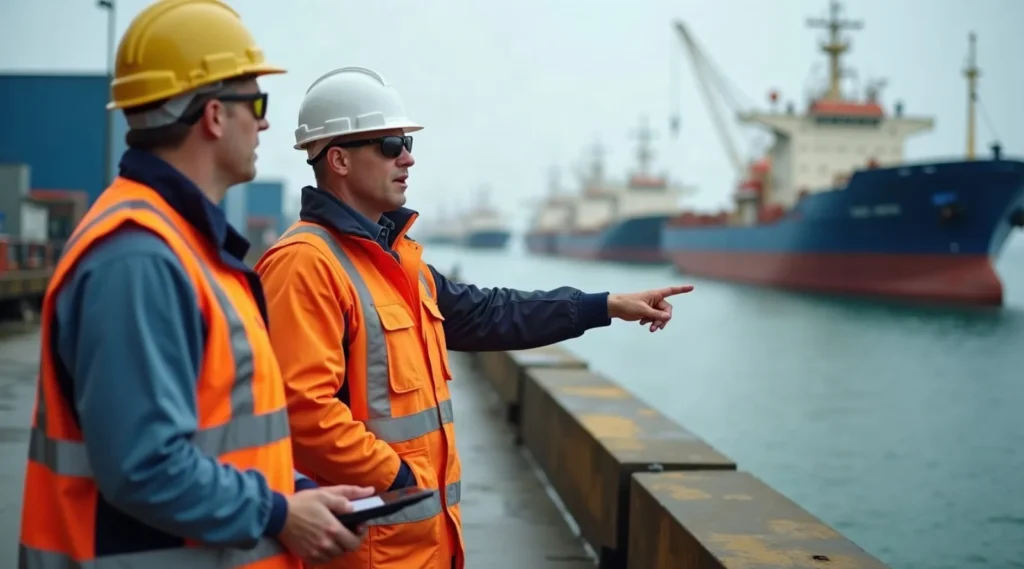
Vetting an Indonesian shipyard before committing a vessel comes down to five verifiable domains: dock capability against your vessel’s actual dimensions, technical capacity in steel and machinery, workload and schedule honesty, commercial and legal standing, and HSE discipline you can see on a walk-through. This is the working checklist our desk uses when shortlisting yards for fleet managers — each item phrased as something you can check, not something you must take on trust.
Domain 1: dock capability — the disqualifying questions first
Start with the items that eliminate yards, because no other strength compensates. Verify against documents, not brochures: maximum LOA, beam and lifting capacity (or dock internal dimensions) of the specific dock offered — not the yard’s biggest dock, the one your vessel would get; draft over the blocks at the tide the docking would use; crane coverage at the dock position; and when that dock itself was last surveyed, since a floating dock with deferred maintenance transfers its problems to your block loading. Ask for the dock’s certificate and a recent docking plan of a similar vessel. A yard that hesitates on these documents has answered the question. The national capacity baseline to check claims against is the National Yard Register.
Domain 2: technical capacity — can they do your scope, at rate
| Check | How to verify |
|---|---|
| Steel throughput | Tonnes renewed on last three comparable dockings; welder certificates sighted |
| Blasting & coating | Equipment list, compressor capacity, DFT instruments in calibration |
| Machine shop | Shaft lathe capacity vs your shaft; in-house vs subcontract for balancing |
| NDT access | In-house or named subcontractor with certs |
| Class familiarity | Recent survey dockings with your class society at this yard |
| References | Two owners of similar vessels docked in the last year — call them |
Swipe the table sideways for every column
The reference calls are the highest-yield twenty minutes in the whole process: ask specifically about growth-work pricing behaviour and schedule slip, the two failure modes brochures never show.
Domain 3: workload and schedule honesty
A capable yard at full capacity is, for your project, not a capable yard. Walk the yard and count: vessels on dock and on the quay, crews actually working versus idle, and the state of ongoing jobs (a dock full of stalled projects is a warning of cash or labour problems). Ask directly how many dockings the yard will run concurrently with yours and how many certified welders your project is allocated — then have that number written into the contract. Ask what happens to your schedule if the yard’s larger customer needs the dock. The honest answer is uncomfortable; the dishonest answer is worse. Schedule behaviour is also the strongest argument for owner-side supervision throughout the stay — the service model is described on our shipyard selection & vetting page.
Domain 4: commercial and legal standing
Five paper checks that take a day and prevent months of trouble: company registration and the yard’s legal identity matching the contract entity (Indonesian yards sometimes contract through affiliates — know who you are in contract with); business licensing appropriate to ship repair; evidence of insurance — ship-repairer’s liability cover and the dock’s own insurances; banking details verified through a second channel before any payment; and for foreign-flag work, the yard’s track record with repair-call customs formalities. Pair these with a payment structure that follows certified work — the mechanics are detailed in our guide to shipyard payment terms in Indonesia — and with tender documents structured so growth work is priced before it is discovered, per the RFQ template guide.
Domain 5: HSE discipline — visible in the first ten minutes
Safety behaviour predicts quality behaviour, and both are visible on a walk-through. Look for: scaffolding with proper boards and tags rather than improvised planks; hot-work permits actually posted where welding happens; gas-freeing certificates for tank work; power cables routed and protected rather than draped through puddles; and PPE worn as habit, not for visitors. A yard that manages sparks and staging manages fit-ups and coatings; a yard that improvises safety improvises everything. For fleet managers, an HSE incident on your vessel is also a direct commercial and reputational exposure — treat this domain as disqualifying, not aspirational.
Turning the checklist into a decision
Score each domain, but weight the failure modes: dock capability and legal standing are pass/fail; technical capacity, workload and HSE grade the risk premium you should price in supervision and schedule buffer. Then keep the file alive — a vetting done once is a photograph, and yards change with management, order books and cash positions; re-verify workload and key staff at every tender even with incumbent yards. Our desk maintains exactly these files across the Indonesian yard landscape and runs the full sequence — shortlist, vet, tender, contract, supervise — as one engagement for fleet managers.
Need a vetted shortlist for your fleet? Send vessel particulars and scope — the desk returns matched Indonesian yards with vetting notes and slot windows, estimates in USD. WhatsApp +62 811-3941-4563 · bd@juaraholding.com.
The one-paragraph summary
Vet in five domains — dock capability, technical capacity, workload honesty, commercial-legal standing, visible HSE — with the first and fourth treated as pass/fail. Verify with documents and reference calls, never brochures; write the allocated welders and concurrent-docking count into the contract; and refresh the file at every tender, because yards change faster than reputations do.
Frequently asked questions
What should a shipyard vetting checklist cover?
Five domains: dock capability against your vessel’s dimensions, technical capacity in steel and machinery, current workload and schedule honesty, commercial-legal standing including insurance, and visible HSE discipline. The first and fourth are pass/fail.
How do I verify a yard’s dock capacity claims?
Ask for the specific dock’s certificate, internal dimensions or lifting capacity, draft over blocks at the relevant tide, and a recent docking plan of a similar vessel — documents, not brochure figures.
What is the most predictive single check?
Reference calls to two owners of similar vessels docked in the last year, asked specifically about growth-work pricing behaviour and schedule slip — the two failure modes marketing never reveals.
How often should vetting be refreshed?
At every tender, even for incumbent yards: workload, key staff and financial condition change quickly. A vetting file is a living document, not a one-time certificate.