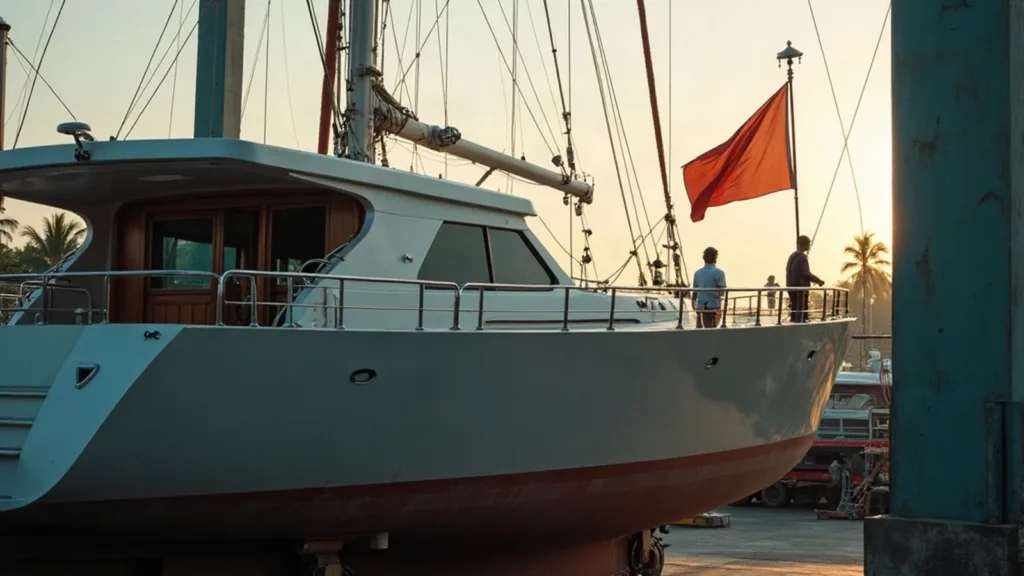
Yes — an Indonesian-built yacht can be registered under a foreign flag, and it happens routinely. The build contract is the easy part. The consequential work sits in flag selection, statutory certification, tonnage, export documentation and, if domestic operation is contemplated, cabotage. All of it should be decided before the specification is written.
Place of build and place of registration are separate
Nothing about constructing a hull in Indonesia obliges the finished vessel to fly the Indonesian flag. Registration is a legal act performed by the chosen flag administration on the basis of ownership, construction evidence and compliance with that flag’s requirements. What building in Indonesia does require, for a vessel destined for a foreign register, is a clean export and a document set that is complete and internally consistent.
Consistency is not a formality. A builder’s certificate stating one length, a tonnage certificate stating another and a bill of sale naming the vessel differently will stall a registration application in any jurisdiction that reads its own paperwork.
Flag drives the technical specification
This is the point most owners discover late. The flag state determines which statutory certificates the vessel must hold and to what standard: safety equipment, life-saving appliances, firefighting, radio, load line, pollution prevention, and — for commercially operated yachts — whichever commercial code the flag applies. Those requirements dictate real equipment: the number and type of liferafts, the fire detection and suppression arrangement, the navigation and communications fit, the escape arrangements, sometimes the structural fire protection of accommodation boundaries.
Specify the vessel first and choose the flag afterwards, and the gap between what was built and what the flag requires becomes a retrofit — done at the end of the programme, when the yard is trying to hand over and every change is disruptive.
Private versus commercial use
| Intended use | Typical consequence |
|---|---|
| Private pleasure use only | Lighter statutory regime under most flags; certain identification schemes may not apply |
| Commercial charter | Commercial yacht coding, additional safety equipment, crew certification, survey regime |
| Domestic Indonesian commercial operation | Cabotage: Indonesian flag and Indonesian legal entity ownership requirements engage |
Swipe the table sideways for every column
The third row is the one that reshapes ownership structures. Indonesia’s cabotage regime reserves domestic sea transport for Indonesian-flagged vessels operated by Indonesian legal entities. An owner planning to charter within Indonesia is therefore answering a corporate structuring question, not only a registration question, and that is properly a matter for qualified Indonesian legal and tax advisers rather than for a shipyard desk.
Export from Indonesia
A vessel leaving Indonesia for a foreign register is an export. The chain includes evidence of construction and ownership — builder’s certificate and bill of sale — class and statutory certificates as applicable, tonnage documentation, the customs export declaration and clearance, and port clearance for departure. Where the yacht sails on its own bottom to its new home port, the delivery voyage brings its own requirements: crew documentation, insurance cover for the passage, and whatever interim or full certification the new flag requires for the voyage itself.
The document sequence is set out in order on our delivery and export page. The recurring failure mode is starting it at delivery week; the fix is starting it when the hull is closed.
Timeline implications for the build
- Concept. Intended use and intended cruising area established.
- Flag selection. Candidate registers compared on statutory regime, commercial coding, ownership requirements and practicality of survey attendance in the region.
- Specification. Written against the chosen flag’s requirements and the chosen class notation.
- Build and survey. Class and, where the flag delegates, statutory attendance run in parallel.
- Tonnage and identification. Measurement completed; identification obtained where the vessel is eligible.
- Registration and export. Registration completed with the new flag; export cleared from Indonesia.
Practical cautions
Three recur. First, surveyor reach: a flag that has no practical survey presence in Southeast Asia turns every inspection into a travel exercise, and the cost of that lands on the owner. Second, wooden hulls: some registers and some commercial codes treat traditionally built wooden vessels differently, and that should be confirmed rather than assumed for a hull built in South Sulawesi. Third, insurance: underwriters have their own view on flag, class and construction, and discovering their position after the vessel is registered is an expensive order of operations.
Getting the sequence right
This desk sequences flag, class, tonnage and export documentation against the physical build programme, so that the paperwork is finished when the vessel is. Construction and vessel-sale contracts are issued by PT Komodo Galangan Nusantara, and all quotations are in USD. Contact bd@juaraholding.com or +62 811-3941-4563. Related: newbuild supervision.
A short worked example
An owner commissions a 30-metre vessel in Indonesia intending private use in Southeast Asia, then decides during the build to offer occasional charter. That single change moves the vessel from a light private regime into a commercial one under most flags: additional safety equipment, crew certification requirements, a different survey regime, and possibly structural fire protection changes in the accommodation. Made at concept stage the change costs a specification revision. Made at outfitting stage it costs a partial rebuild of the interior boundaries.
The lesson generalises. Flag and use are the same decision, and they belong at the front of the programme with the naval architect in the room.
Frequently asked questions
Does building in Indonesia force Indonesian flag?
No. Place of construction and place of registration are separate decisions. What building in Indonesia does require, if the vessel is to be flagged elsewhere, is a lawful export of the vessel and a complete, consistent set of ownership and construction documents.
Can a foreign-flagged yacht operate commercially between Indonesian ports?
Domestic sea transport between Indonesian ports is reserved under the national cabotage regime for Indonesian-flagged vessels operated by Indonesian legal entities. A vessel intended for domestic commercial operation therefore faces a structural question that a purely export vessel does not.
When should the flag decision be made?
Before the technical specification is written. Flag determines which statutory certificates and equipment standards apply, and those requirements shape equipment selection, arrangement and even structure.