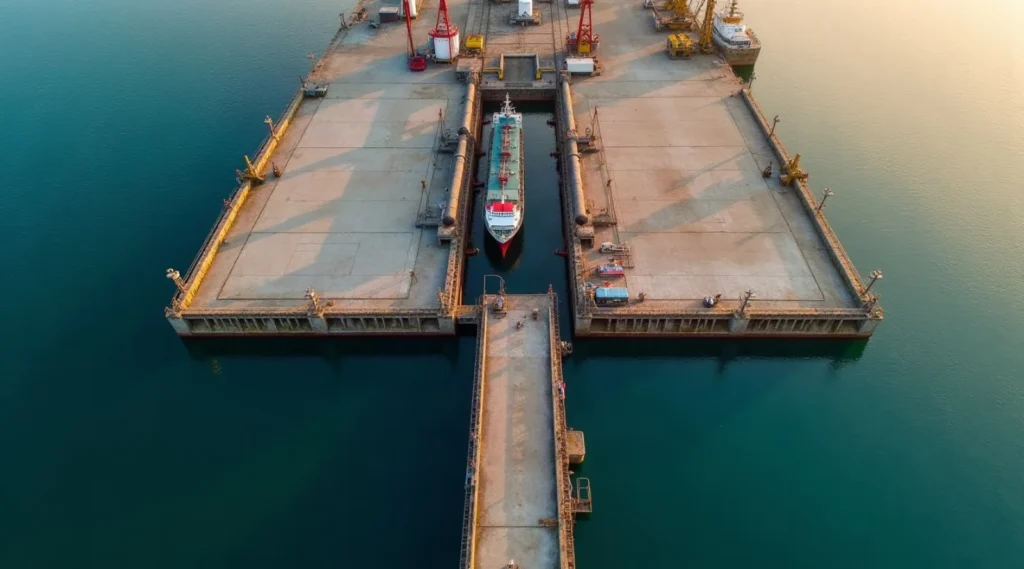
A graving dock is a fixed concrete basin that is pumped dry after the ship enters; a floating dock is a submersible steel pontoon that rises under the ship. Graving docks win on lifting capacity, stability for heavy steel work and long refits; floating docks win on availability, docking speed and cost for small and mid-size tonnage — which is why they dominate the Indonesian repair market. Here is the full comparison an owner needs when choosing between them.
How each dock actually works
A graving dock (also called a dry dock proper) is excavated into the shoreline: the ship floats in over pre-set keel blocks, a gate or caisson closes behind her, and pumps empty the basin over several hours until the ship rests on the blocks. The structure is civil engineering — concrete, gates, pump houses — and lasts generations. A floating dock is itself a vessel: a U-shaped steel pontoon that ballasts down until its deck is deep enough, receives the ship between its wing walls, then pumps its tanks dry and rises, lifting the ship with it. Its capacity is expressed as lifting capacity in tonnes, and like any steel vessel it needs its own maintenance, surveys and eventually its own docking.
Head-to-head comparison
| Factor | Graving dock | Floating dock |
|---|---|---|
| Capacity ceiling | Highest — the largest ships afloat | Limited by pontoon lifting capacity |
| Stability for heavy work | Excellent; solid ground | Good, but deflection must be managed |
| Docking/undocking speed | Slower (gate + pump cycle) | Faster; flexible scheduling |
| Availability in Indonesia | Few, concentrated at major yards | Widespread across the archipelago |
| Typical cost position | Higher dues, larger minimums | Lower entry cost for small/mid tonnage |
| Weather exposure | Protected basin | More exposed; siting matters |
| Best for | Long refits, heavy steel, big ships | Routine dockings, survey cycles, fast turnarounds |
Swipe the table sideways for every column
What this means in the Indonesian market
Indonesia’s repair capacity is overwhelmingly floating-dock capacity. Graving docks exist at the major state and private yards on Java and Batam, and they are booked by larger tonnage and government programmes first. For the small and mid-size vessels that make up most of the national fleet — tugs, landing craft, ferries, coasters, fishing and tourism vessels — the realistic docking slot is a floating dock, a slipway or an airbag haul-out. Practical consequence one: if your vessel needs a graving dock, book months ahead. Practical consequence two: when comparing quotations, check which dock the yard is actually offering — a lower quote on an overloaded floating dock with a queue is not a lower cost once off-hire days are counted. Capacity by yard and region is listed in the National Yard Register.
Auxiliary floating dry docks and self-docking
Two related terms appear in searches and deserve a note. An auxiliary floating drydock is the naval term for mobile floating docks used by fleets to service vessels away from fixed bases — the same engineering as commercial floating docks, historically significant in the Pacific. Self-docking refers to a floating dock’s own periodic maintenance: sectional docks can lift one of their own sections onto the others for survey and repair. For an owner this matters only indirectly — but it is worth asking a yard when its floating dock was last surveyed, because a pontoon with deferred maintenance deflects more, and block loading on your hull is affected by it.
Choosing correctly for your vessel and scope
The decision tree we use at the desk is short. If the vessel exceeds regional floating-dock capacity, or the scope involves major steel renewal, lengthening or conversion, target a graving dock and accept the queue — the working conditions repay it; our dry dock & haul-out guide maps which Indonesian options fit which LOA and tonnage bands. If the scope is a routine docking survey with moderate steel and coating, a well-run floating dock is usually the efficient answer, and slot availability across several yards becomes your negotiating room. If the vessel is small enough for a slipway or airbags, the entry cost drops again — what matters then is the yard’s block plan and washing/blasting discipline rather than the lifting method itself. For the basics of what happens once the ship is dry, see what a dry dock is and how it works.
Cost behaviour: where the two types differ on the invoice
Dock dues are structured differently: graving docks tend to carry higher daily dues and larger minimum charges, floating docks price keener but concentrate on volume throughput — their business is many short dockings. The bigger financial difference is indirect. Graving-dock yards typically carry heavier engineering capability (plate shops, machine shops, cranage), so complex work proceeds without subcontractor delays; floating-dock yards vary widely, and an ambitious scope at a thin yard produces schedule slip that dwarfs any difference in dues. Matching scope to yard capability — not chasing the lowest dock fee — is the single biggest cost decision, and it is exactly what our USD budgeting method in the dry docking cost guide is built around.
Not sure which dock type fits your vessel? Send LOA, beam, GT and scope to the desk — we reply with matching Indonesian yards, dock types and slot windows, in USD. WhatsApp +62 811-3941-4563 · bd@juaraholding.com.
Frequently asked questions
What is the difference between a graving dock and a floating dock?
A graving dock is a fixed basin pumped dry after the ship enters and rests on blocks; a floating dock is a submersible steel pontoon that rises under the ship and lifts her clear of the water. Graving docks favour size and heavy work; floating docks favour speed, availability and cost.
Which is more common in Indonesia?
Floating docks by a wide margin, spread across the archipelago’s repair yards. Graving docks are concentrated at the major yards on Java and Batam and are typically booked by larger tonnage first.
Is a floating dock safe for heavy steel renewal?
Yes, within the dock’s lifting capacity and with proper block planning — but very heavy renewals, lengthening and conversions are better done in a graving dock, where stability and adjacent workshop capability are stronger.
What is an auxiliary floating drydock?
The naval designation for mobile floating docks used to service vessels away from fixed bases — engineering identical in principle to commercial floating docks used across Indonesian yards today.