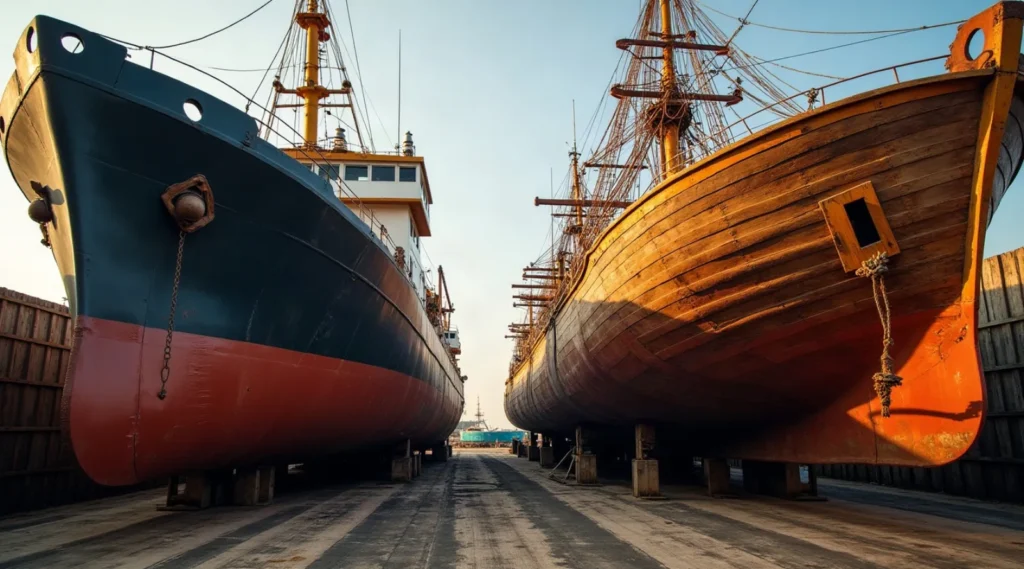
Steel wins on lifespan, class treatment, resale liquidity and repair availability across Indonesia; timber wins on entry cost at traditional yards, character value in the charter market, and repairability far from industrial docks. The right answer follows the vessel’s job: commercial tonnage and long-horizon owners build steel; heritage-charter operators can still make timber pay.
Answer first: when steel wins, when timber wins, in Indonesian yards
Indonesia is one of the few places on earth where this question is still genuinely open: the country runs a full industrial steel shipbuilding sector alongside a living traditional timber tradition. Choose steel when the vessel is a working asset — cargo, support, survey, dive-operations, long-service charter — where class treatment, insurance, financing and resale all favour welded plate. Choose timber when the vessel’s commercial identity depends on it: the heritage charter segment prices authenticity, and a fine timber hull built by master craftsmen is the product, not just the platform. The mistake is drifting between the two on cost grounds alone — because the cost story changes shape over ten years, as the tables below show.
Cost structure compared (USD, per-metre bands)
Indicative planning bands from desk experience across Indonesian yards, hull and structure stage (excluding machinery, electronics and interior fit-out, which are broadly material-independent). Every build prices individually — treat these as screening ranges and request a scoped estimate for real numbers.
| Build type | Indicative hull cost band | Where built | Cost drivers |
|---|---|---|---|
| Timber hull, traditional build, 25–40 m | USD 6,000–14,000 per metre | Traditional yards (South Sulawesi tradition) | Timber species and sourcing, craftsman crew, season |
| Timber hull, premium charter finish, 30–50 m | USD 12,000–25,000+ per metre | Traditional yards + specialist fit-out teams | Selected timbers, systems integration, finish level |
| Steel hull, workboat standard, 25–45 m | USD 8,000–16,000 per metre | Java, Batam, Kalimantan industrial yards | Plate prices, welding hours, class involvement |
| Steel hull, classed commercial, 40–70 m | USD 14,000–28,000+ per metre | Surabaya, Lamongan, Batam | Class scope, outfitting density, equipment standard |
Swipe the table sideways for every column
Two structural notes. Steel pricing is transparent and tender-able — plate, consumables and hours can be normalised across competing yards. Timber pricing is relationship-priced and season-dependent: quality timbers are a supply chain, not a commodity, and the builder’s reputation is the specification.
Yard availability: which register segments build each material
Steel newbuild and repair capacity spans the whole industrial register — Batam, Java, Sulawesi, Kalimantan — with deep welding labour pools and plate supply. Timber construction concentrates in the traditional building centres of South Sulawesi and allied coastal communities, with haul-out and repair support at slipways through the East. Practical consequence: a steel vessel can be repaired to standard in any major cluster of the National Yard Register; a timber vessel’s serious structural work belongs with builders who know its construction tradition — capacity that is real but geographically specific.
BKI and survey treatment: steel vs timber vs aluminium
Steel is class’s native language: thickness gauging, renewal criteria and weld standards are fully codified, which is why financing and insurance favour it. Classed timber vessels are surveyed under BKI’s wooden-ship rules — hull fastenings, caulking and member condition — with surveyor judgement carrying more weight and fewer numerical certainties. Aluminium occupies a specialist niche (crew boats, fast workboats) with its own welding qualifications; only a defined subset of yards holds certified aluminium capability. If the vessel’s future involves charter licensing, foreign flag or institutional finance, the class pathway should be decided before the material, not after — see BKI class & compliance.
Lifecycle: maintenance intervals, replating vs rewooding, resale
| Dimension | Steel | Timber |
|---|---|---|
| Docking rhythm | Class cycle: twice per 5 years | Practical tropical rhythm: bottom attention every 12–24 months |
| Mid-life structural work | Replating by gauging results, predictable USD/kg | Member and plank renewal, craftsman-dependent |
| Corrosion / biological risk | Corrosion — managed by coatings and anodes | Marine borers and rot — managed by sheathing, coatings, vigilance |
| 20-year outlook | Routinely economic with maintenance | Achievable, but hull condition dominates value |
| Resale market | Liquid, spec-driven, finance-friendly | Niche, story-driven, condition-sensitive |
Swipe the table sideways for every column
Over a decade, steel’s maintenance is more predictable and its resale market broader; timber demands more frequent attention but rewards it in a charter market that pays for character. Owners planning exit within five to seven years should weight resale liquidity heavily — it is the line where the materials diverge most.
Commissioning a build: route to the group’s construction division
For owners who want a single accountable route from concept to launch, Komodo Luxury’s custom vessel construction division runs complete build programmes end to end, while this desk remains the independent register for yard-by-yard material capability.
Owners arriving at a build decision can take both roads through this ecosystem: industrial steel programmes are tendered and supervised through this desk against the national register, while fully custom vessel programmes — including premium timber builds in the traditional tradition — run through the group’s specialist construction division. Either way, the decision sequence is the same: define the vessel’s commercial job, fix the class pathway, then let material and yard follow. We help owners run that sequence before a single dollar is committed.
Talk the decision through: WhatsApp +62 811-3941-4563 · bd@juaraholding.com. Quotations coordinated in USD.
Frequently asked questions
Is a steel hull cheaper than timber to build in Indonesia?
At workboat standard the bands overlap — entry-level timber can undercut steel, while classed steel and premium timber both climb well beyond either baseline. The structural difference is pricing transparency: steel tenders can be normalised across yards; timber is relationship- and season-priced.
How does BKI survey a wooden vessel differently from steel?
Steel is surveyed numerically — thickness gauging against renewal criteria. Timber is surveyed under wooden-ship rules by condition: fastenings, caulking, member soundness — with more surveyor judgement and a docking rhythm that practical tropical operation pushes toward every one to two years.
Which Indonesian yards work in aluminium?
A defined specialist subset, mainly serving crew boats and fast workboats, holding certified aluminium welders and dedicated tooling. Aluminium scope should never be placed at a steel-only yard; we shortlist specifically for certified capability when the hull demands it.
What are the maintenance cycle differences over 10 years?
Steel: dockings on the class cycle, coatings and anodes between, replating by gauging results late in the period — predictable and budgetable. Timber: bottom attention every 12–24 months, sheathing and caulking upkeep, and craftsman-dependent member renewal — more frequent, less predictable, manageable with discipline.
Can a timber design be re-engineered for steel construction?
Yes — hull lines can be re-engineered in welded steel while keeping the profile the charter market recognises, and several operators have taken that route for class and longevity reasons. It is a naval-architecture exercise: structure, stability and freeboard are recalculated for the new material and re-approved by class.