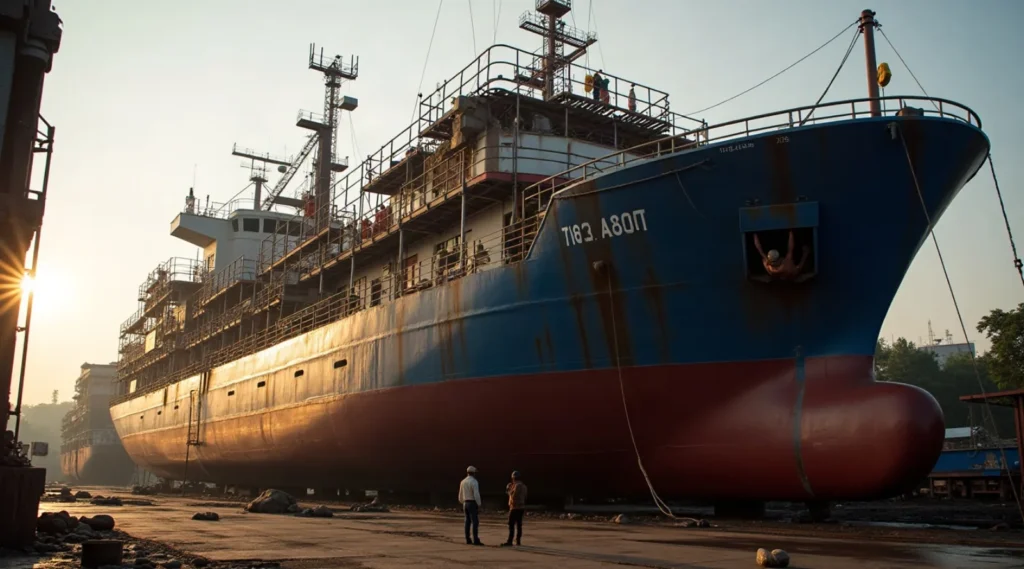
A 30–60 m steel vessel can be refitted at a dozen-plus Indonesian yards — Surabaya and Batam for heavy scope, Makassar and Lamongan for structured mid-scope work. The sequence that protects your budget: lock the scope against survey requirements, match the yard to the dominant work package, order long-lead items before docking, and keep owner-side oversight on site from arrival to redelivery.
Answer first: which Indonesian yards can refit a 30–60 m steel vessel, and how to sequence it
Refit is not repair with a bigger invoice — it is a project, with dependencies that punish improvisation. The 30–60 m steel band (workboats, small cargo, liveaboards, crew and support vessels) fits floating docks and larger slipways nationwide, so availability is rarely the problem. The problem is sequencing: owners who dock first and scope second pay for lay days while decisions are made, and pay again when growth work is priced mid-dock. The desk’s refit method runs scope → yard → long-lead procurement → dock window → supervised execution, in that order, with USD budgets fixed per package before the vessel arrives.
Refit classes we manage
Class-driven refit (steel + survey items)
Built around a special survey: thickness gauging first, steel renewal quantities agreed from the gauging report, survey items (sea valves, shafting, anchors and chain) folded into the same dock period. The gauging report is the contract’s backbone — without it every steel number is a guess in the yard’s favour.
Systems & machinery upgrade
Repowering, generator replacement, electrical modernisation, navigation and safety-equipment renewal. The critical path is almost always procurement, not labour: engines and switchboards can carry long lead times, so we order against the dock date, not after it.
Interior & accommodation refit
Crew and guest accommodation, galleys, HVAC, insulation and fit-out — the dominant package for charter and liveaboard tonnage. Indonesian joinery quality can be excellent at yard prices, provided materials are specified by the owner’s side and moisture/fire standards are enforced during installation, not inspected after closing panels.
Conversion & lengthening
Role changes (cargo to accommodation, fishing to survey work) and hull lengthening are established practice at Indonesian yards. Both trigger class involvement from drawing stage: stability, structure and freeboard must be re-approved. We coordinate the design package, class file and yard execution as one thread so approvals never idle the dock.
Yard capability matrix for refit work (30–60 m steel)
| Cluster | Best-fit refit package | Strengths | Watch items |
|---|---|---|---|
| Surabaya | Heavy steel, conversion, lengthening | Engineering depth, class proximity, machining shops | Slot lead time at flagship docks |
| Batam | Machinery, systems, fast steel scope | Subcontractor pool, parts logistics, FTZ import | QA variance between yards; vetting essential |
| Makassar | Mid-scope steel + interior, eastern fleets | Regional base, competitive dues | Specialist trades may travel from Java |
| Lamongan | Structured steel packages, newbuild-adjacent work | Fabrication capacity, launch/haul options | Owner-supplied equipment logistics |
| Eastern slipways | Light refit, coatings, timber/steel charter fleet | Near operating grounds, low mobilisation | Limited crane and shop capacity |
Swipe the table sideways for every column
Full cluster capacity, dock types and tonnage bands are in the National Yard Register.
Sequencing: survey, dock window, long-lead items
The refit calendar works backwards from two anchors: the class survey due date and the vessel’s next earning commitment. Between them we place: (1) gauging and scope freeze, ideally one voyage before docking; (2) tender and yard selection, two to three months out; (3) long-lead purchase orders the same week the yard is signed; (4) the dock window itself, sized to the steel package with a defined growth-work protocol; (5) afloat completion of interior and commissioning where possible, so paid dock days end when hull work ends. A typical class-driven refit in this band runs four to ten weeks in yard hands; conversions run longer and are governed by approval milestones. Budget bands per package are in the USD cost guide.
Refit supervision & remote oversight for absent owners
Most refit clients are not in Indonesia. Our oversight model is built for that: a supervisor at the yard through every working day, a photographic day-log delivered each evening, weekly cost-to-complete reporting in USD, and hold points the yard cannot pass without owner-side sign-off — steel fit-up, coating surface prep, machinery alignment, tank closing. Video walk-downs are scheduled to the owner’s time zone. The result is a redelivery with documentation you can hand to class, insurers and the next buyer without apology.
Start with a scope conversation: WhatsApp +62 811-3941-4563 · bd@juaraholding.com. Quotations coordinated in USD.
Frequently asked questions
Which shipyard in Indonesia can refit a 40 m steel vessel?
A 40 m steel vessel fits floating docks and larger slipways in every major cluster — Surabaya, Batam, Makassar and Lamongan all qualify on geometry. Selection turns on the dominant work package: heavy steel favours Surabaya, machinery and systems favour Batam, eastern-based fleets often balance capability against repositioning by choosing Makassar.
Who can supervise my vessel refit remotely in Indonesia?
Our desk provides owner-side supervision designed for absent owners: daily photographic logs, weekly USD cost-to-complete reports, defined hold points, and scheduled video walk-downs in your time zone. You keep decision authority; we keep presence at the yard.
How long does a class-driven refit take at an Indonesian yard?
For 30–60 m steel vessels, four to ten weeks in yard hands is the working range — governed by steel tonnage, coating windows and survey scheduling. Conversions and lengthening run longer because class approval milestones enter the critical path.
Can Indonesian yards do conversion or lengthening projects?
Yes. Hull lengthening and role conversions are established practice, particularly at Surabaya and Lamongan yards with fabrication depth. Both require class re-approval of stability and structure from the drawing stage, which we coordinate as part of the project thread.
How is a refit budget structured in USD?
By package: docking and dues; steel (rate × gauged quantity); coatings (area × system); machinery and systems (equipment + installation); interior (materials + trades); plus a contingency held against a written growth-work protocol. Each package carries its own USD number and its own acceptance criteria before work starts.
From the Journal
- Perbaikan Baling-Baling & Poros Kapal: Proses, Toleransi, dan Uji Balans
- Antifouling and Hull Coating in Tropical Waters: Intervals That Actually Hold