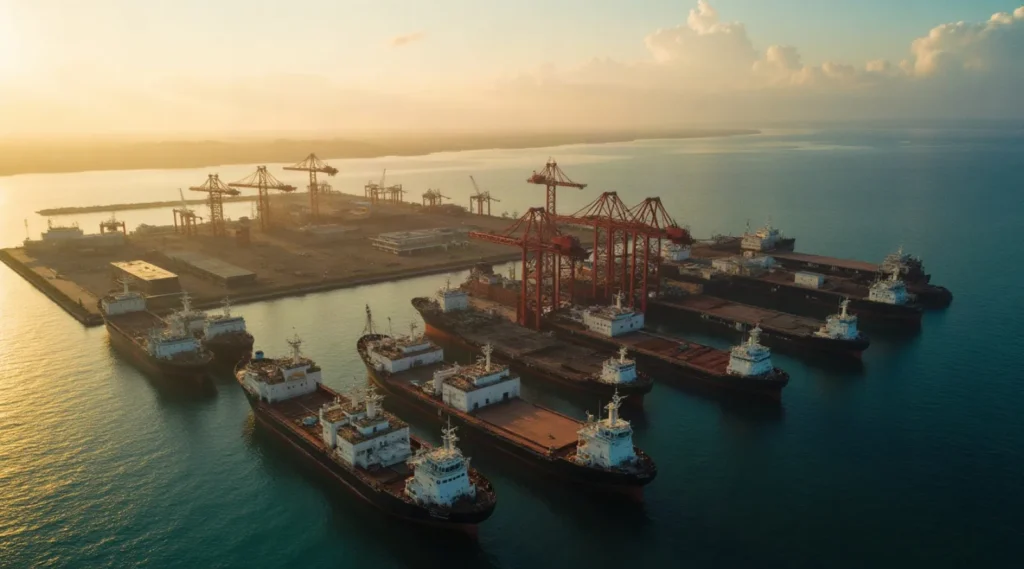
Indonesia operates more than 250 registered shipyards, but fewer than 40 can dry dock a vessel above 5,000 DWT. The working capacity concentrates in four clusters — Batam–Riau Islands, Java (Jakarta, Surabaya, Semarang, Lamongan), Sulawesi–Kalimantan, and Eastern Indonesia — and the right yard for your vessel depends on dock type, maximum LOA, tonnage band, and BKI standing. This register organises all four clusters so an owner can shortlist in minutes, not weeks.
Answer first: how many working shipyards does Indonesia have, and which can take your vessel?
The Ministry of Industry and shipyard association records list well over two hundred galangan across the archipelago, from village slipways hauling 30 GT fishing boats to state-owned graving docks that accept ocean-going tonnage. For a commercial owner the practical question is narrower: which yards have a dock that fits your LOA and draft, a crane and steel shop that match your scope, and a survey record that satisfies your class society. That filtered list is usually 5–15 yards nationally, and this register is built to find them.
Three rules of thumb before you read the table. First, dock geometry beats distance: sailing three days to a dock that fits is cheaper than forcing a marginal fit nearby. Second, tonnage bands are indicative — every yard quotes against your actual docking plan, so treat published maxima as a screening filter, not a booking guarantee. Third, BKI-classed vessels should confirm the yard’s current standing with surveyors before committing a lay-day schedule; approvals and dock certificates are renewed on cycles and do change.
The National Yard Register: capacity table
The register below is maintained by our desk from yard disclosures, port records and project experience. Figures are indicative screening bands — final acceptance always depends on the yard’s current dock certificate, block plan and schedule. Request a verified shortlist for your vessel via WhatsApp and we confirm live availability directly with the yards.
How to read the columns
Each row shows: region · dock type (graving / floating / slipway / airbag) · indicative max LOA · indicative tonnage band · typical vessel classes handled. Where a cluster contains many yards of similar profile (Batam especially), the row summarises the cluster segment rather than naming every gate.
Batam & Riau Islands cluster
| Segment | Dock type | Max LOA (indicative) | Tonnage band | Typical vessels |
|---|---|---|---|---|
| Batam large private yards | Graving & large floating docks | 180–300 m | to ~80,000 DWT | Bulkers, tankers, container feeders, offshore units |
| Batam mid-tier yards | Floating docks, slipways | 60–120 m | 500–10,000 GT | Tugs, barges, OSV, small tankers |
| Karimun & Tanjung Uncang fringe | Slipways, fabrication quays | to ~90 m | to ~5,000 GT | Newbuild barges, LCT, repair afloat |
Swipe the table sideways for every column
Batam is Indonesia’s densest repair market: FTZ logistics, proximity to Singapore anchorages, and the country’s deepest pool of subcontractors. Pricing is competitive but slot discipline varies by yard — vetting matters more here, not less.
Java: Jakarta, Surabaya, Semarang, Lamongan
| Segment | Dock type | Max LOA (indicative) | Tonnage band | Typical vessels |
|---|---|---|---|---|
| Jakarta state-owned docks (Tanjung Priok) | Graving & floating | to ~150 m | to ~20,000 DWT | Cargo, ferries, government fleet |
| Surabaya state & private yards | Graving, floating, slipway | to ~190 m | to ~50,000 DWT | Newbuild & repair, naval, tankers, ro-ro |
| Semarang & north-coast yards | Floating docks, slipways | to ~100 m | to ~8,000 GT | Coasters, ferries, fishing fleet |
| Lamongan shipbuilding belt | Slipways, airbag launch, graving | to ~120 m | to ~10,000 GT | Newbuild LCT, barges, tugs, repair |
Swipe the table sideways for every column
Java combines the deepest engineering talent with the country’s main state-owned yards. Lead times at flagship docks can be long around fleet survey seasons; booking two to four months ahead is normal for planned dockings.
Sulawesi & Kalimantan
| Segment | Dock type | Max LOA (indicative) | Tonnage band | Typical vessels |
|---|---|---|---|---|
| Makassar industrial yards | Graving, slipway | to ~120 m | to ~10,000 GT | Cargo, ferries, pinisi-hull conversions |
| Bitung (North Sulawesi) | Slipway, floating | to ~90 m | to ~5,000 GT | Fishing fleet, coasters |
| Balikpapan & Banjarmasin | Floating docks, airbag | to ~110 m | to ~8,000 GT | Coal barges, tugs, OSV |
Swipe the table sideways for every column
The Sulawesi–Kalimantan corridor serves the coal, nickel and fisheries fleets. Airbag haul-out has expanded rapidly here for barges and tugs; it is cost-effective but demands stricter supervision of block loading and hull support.
Eastern Indonesia
| Segment | Dock type | Max LOA (indicative) | Tonnage band | Typical vessels |
|---|---|---|---|---|
| Ambon & Sorong | Slipway, small floating | to ~70 m | to ~2,500 GT | Ferries, fishing, government vessels |
| Kupang & Maumere | Slipway, beach-gridiron | to ~60 m | to ~1,500 GT | Inter-island coasters, LCT |
| Charter-fleet haul-out (NTT/Maluku) | Slipway, airbag | to ~55 m | to ~500 GT | Liveaboards, timber & steel charter vessels |
Swipe the table sideways for every column
Eastern capacity is thinner and scopes are simpler; for major steel or machinery work, eastern-based fleets routinely reposition to Surabaya or Makassar. Our desk plans that trade-off — repositioning cost against yard capability — as part of every eastern shortlist.
How to read the register: dock type vs your vessel
Graving dock
A concrete basin below water level with a gate. Best stability for heavy steel renewal, shaft withdrawal and long refits; usually the highest dock dues. Entry is governed by dock length, breadth at entrance and sill depth versus your draft.
Floating dock
A submersible steel pontoon that lifts the vessel. Faster cycles and often better pricing; lifting capacity in tonnes — not just LOA — is the binding constraint, so displacement matters more than length.
Slipway & airbag haul-out
Rail slipways and rubber-airbag beaching suit tugs, barges, LCTs, fishing vessels and charter fleets up to roughly 2,500 GT. The lowest-cost access to the hull, but block plans, pulling gear and side support deserve real scrutiny — this is where supervision pays for itself fastest.
State-owned vs private yards (BUMN vs swasta)
State-owned yards (BUMN) anchor the heavy end: large graving docks, naval and government work, formal tender procedures, strong documentation. Private yards dominate volume repair: faster commercial response, sharper pricing, wider variance in QA. Neither category is automatically better. A disciplined private yard in Batam can out-deliver a congested state dock; a BUMN dock can be the only geometry that fits a 160 m hull. We shortlist by scope fit first, ownership second — then verify the specific dock, not the brand.
Using this directory: request a shortlist from the desk
What we need from you
Send five data points and we return a verified shortlist, usually within two working days: (1) LOA, beam and loaded draft; (2) GT/DWT and displacement if known; (3) class status and next survey due dates; (4) work scope summary — steel, machinery, coatings, outfitting; (5) target docking window and current trading area. Quotes are coordinated in USD; official government fees may appear in IDR.
Talk to the desk
WhatsApp +62 811-3941-4563 or email bd@juaraholding.com. The desk is independent of every yard in this register: we are paid to represent the owner’s interest, not to fill any dock. See how we run shipyard selection & vetting, or start from the USD docking cost guide.
Frequently asked questions
Where can I find a complete list of shipyards in Indonesia with contacts?
No single public list is complete or current. Association and ministry registers cover licensing, not live capacity. This register consolidates the working commercial yards by cluster; for contactable, capacity-verified shortlists matched to a specific vessel, request one from our desk — we confirm dock certificates and slots directly with the yards.
Which shipyards in Indonesia have dry dock facilities for bulk carriers?
Handysize and Supramax bulkers dock mainly in Batam’s large private yards and at Surabaya’s state-owned graving docks. Above roughly 80,000 DWT, options narrow sharply and many owners weigh regional alternatives; below that, Indonesia offers genuine choice at competitive USD rates.
Which Indonesian shipyards can handle vessels over 100 metres?
The 100 m+ band is served by the Batam large-yard segment, Surabaya and Jakarta state docks, and select Lamongan facilities. Practical acceptance depends on entrance breadth, sill depth and lifting capacity, so we always verify the specific dock against your docking plan before shortlisting.
Apa saja daftar galangan kapal BUMN dan swasta di Indonesia?
Galangan BUMN terkonsentrasi di Jakarta, Surabaya dan Makassar dengan dok gali besar dan prosedur tender formal. Galangan swasta terbesar berkumpul di Batam, disusul Lamongan dan Kalimantan. Panduan berbahasa Indonesia tersedia di halaman Galangan Kapal Indonesia.
What are the top ship repair yards in Indonesia in 2026?
“Top” depends on scope: for heavy steel and machinery, the Surabaya state docks and Batam’s large private yards lead; for fast commercial dockings under 10,000 GT, disciplined Batam mid-tier yards typically win on turnaround; for eastern fleets, Makassar is the strongest regional base.
Can a 300 m container ship dry dock in Indonesia?
Routine dockings above roughly 300 m are not the Indonesian market’s strength; capacity at that length is exceptional rather than commercial. Vessels of that size generally dock elsewhere in the region, while Indonesia remains highly competitive for the sub-200 m fleet.