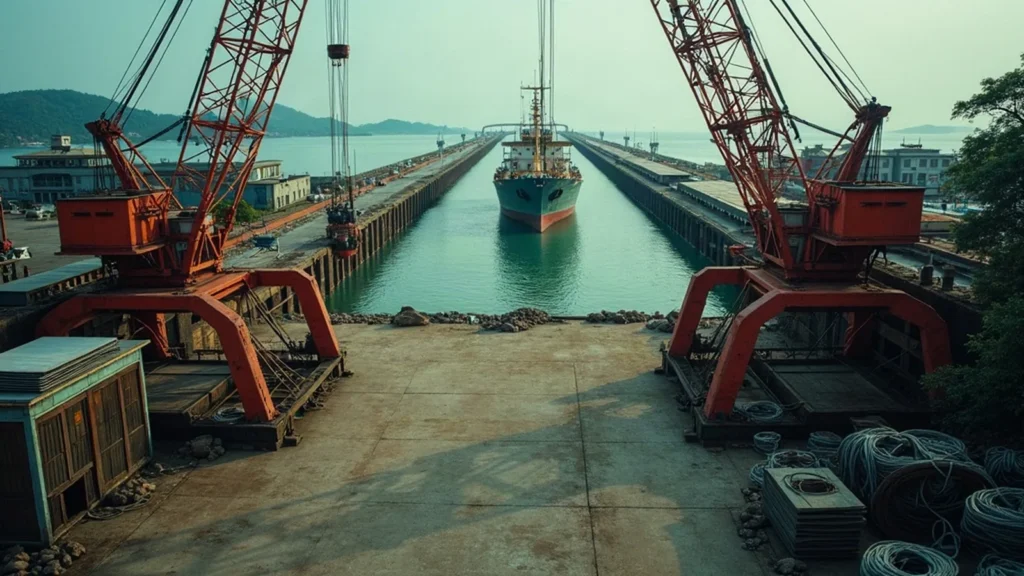
Indonesian yards sell six distinct service families: newbuild construction, newbuild supervision, repair, refit, docking, and class and statutory support. They are priced differently, they are concentrated in different provinces, and they fail for different reasons. This page sets out what each family actually contains and what determines whether a given yard can deliver it.
1. Newbuild construction
Building a hull from nothing. In Indonesia this splits sharply by material. Steel newbuild — tugs, barges, crew boats, landing craft, offshore support vessels, small tankers — is concentrated in Batam, Surabaya, Semarang, Banjarmasin and Lampung, in yards that work from production drawings, cut plate to a nesting plan and build in blocks. Wooden newbuild — including large traditional sailing hulls — is concentrated in South Sulawesi, where the method is shipwright-led rather than drawing-led and the sequence is entirely different.
The practical consequence: a steel programme is tendered on drawings and a specification, while a wooden programme is tendered on a hull form, a schedule of scantlings, and the reputation of a named shipwright team. Applying the wrong tender method to either produces an unbuildable contract.
This operation is one node in a wider network — full-lifecycle maritime services operator connects build, repair, management and charter under one group.
2. Newbuild supervision and project management
The owner-side function: writing the specification, running the tender, attending the yard, and holding the milestone gates. It is the smallest line in the budget and the one that most reliably determines whether the other lines hold. Detailed on the newbuild project management page.
3. Repair
Restoring a vessel to its certified condition. Steel renewal to class-approved thickness, plate and frame replacement, shaft and stern-gear work, rudder and steering repair, machinery overhaul, pipework and tank work, electrical rectification. Repair is scoped from evidence — thickness measurement reports, survey findings, class conditions — never from a walk-round. Detail on the repair and refit page.
4. Refit
Changing what the vessel is, rather than restoring what it was. Re-engining, tank and range changes, deck layout changes, accommodation and interior rebuilds, generator and HVAC upgrades, tender and davit installation, charter-readiness works. Refit carries stability and certificate consequences: any material change to weight, arrangement or capacity may require re-inclining, re-measurement of tonnage, or a fresh class approval of the modified arrangement.
5. Dry docking, slipway and haul-out
The physical act of getting the vessel out of the water and the survey window it creates. Availability, not price, is the binding constraint — dock and slip slots in the active clusters are committed weeks ahead, and a missed slot usually costs more than the docking itself. Lift limits, cradle geometry, tidal windows and hull form all narrow the list of docks that can physically take a given vessel. Covered on the dry dock and haul-out page.
6. Class and statutory support
Biro Klasifikasi Indonesia plan approval and survey attendance, statutory certification through the Directorate General of Sea Transportation, tonnage measurement, IMO number application where the vessel qualifies, and registration or export documentation. Regulatory work is sequential and unforgiving of shortcuts: a certificate that depends on an earlier certificate cannot be accelerated by paying more. See class and compliance and delivery and export.
Matching service to yard
| Service family | Binding capability question |
|---|---|
| Steel newbuild | Block build capacity, crane reach, covered fabrication area, class-surveyed delivery history |
| Wooden newbuild | Named shipwright team, timber sourcing and seasoning, launch-way length |
| Steel repair | Dock length and beam, plate handling, certified welders for the class procedure |
| Systems & interior refit | Trade availability, workshop cleanliness, logistics for imported equipment |
| Docking | Lift or dock capacity, draught over sill, slot availability in the required window |
Swipe the table sideways for every column
How scope is priced
Every scope from this desk is issued in USD and is built from three separable parts: yard work, owner-supplied equipment, and supervision. Keeping them separate is what allows an owner to change one without renegotiating the others. It also prevents the single most common Indonesian yard dispute — an all-in lump sum that quietly excludes staging, cleaning, gas-freeing, tank access or waste disposal, all of which are then charged as extras.
To scope a programme, send vessel particulars and the intended trade to bd@juaraholding.com or +62 811-3941-4563. The regional capability map is in the shipyard directory.
Frequently asked questions
What shipyard services can realistically be bought in Indonesia?
Steel and aluminium newbuild up to large commercial sizes, wooden and composite newbuild, conversion and lengthening, steel renewal and hull repair, machinery overhaul, systems and interior refit, dry docking and slipway haul-out, and class and statutory survey support. Capability is unevenly distributed between regions, so the yard shortlist matters more than the service list.
Is one yard able to do all of it?
Rarely. Large steel repair capacity and skilled wooden shipwright capacity sit in different provinces, and interior and systems refit trades cluster near charter markets rather than near dry docks. Most multi-scope programmes are split between a hull yard and a fit-out location, with the transit leg planned as part of the scope.
Who issues the contract for shipyard work?
Construction, repair, refit and vessel-sale contracts arranged through this desk are issued by PT Komodo Galangan Nusantara. Vessel management contracts are issued by PT Komodo Vessel Management and brokerage by PT Komodo Bahari Nusantara. They are separate agreements with separate fees.